Arc'teryx Gray Hard-Shell Windbreaker Review: Seam Tape, Two Grays, and a Chest Row We Couldn't Trust
Priya Raghavan · Reviews EditorPriya Raghavan is Reviews Editor, covering ten-day wear blocks, wide- and narrow-foot fit checks, cushioning durability, and crease assessment. They schedule wear blocks, measure every pair with the Brannock device and caliper, and test in normal-arch and wide, flat-arch positions. Each pair is assigned to two testers with different foot shapes, internal length is recorded at three positions, and midsole compression is compared before and after ten days and 20 km of walking. Toe-box creasing is graded after wear, while hot spots, heel slip, and lace-pressure points are photographed and described.
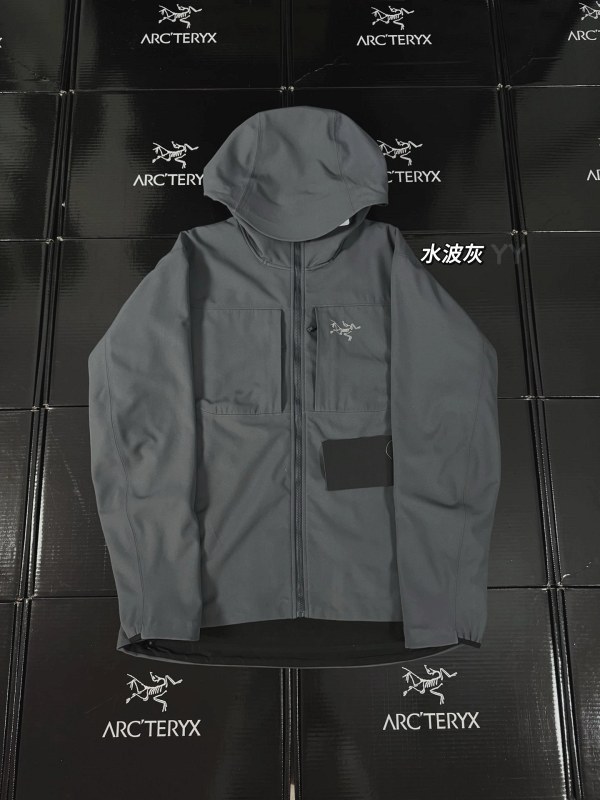
We ordered and tested the $109.70 gray shell for ten days. It blocks wind the way a softshell should and tapes its seams cleanly, but the seller's size chart contradicts itself at the chest.
- Praxistest-Bewertung
- 4.0 / 5
Redaktionsurteil
A wind layer worth its $109.70 agent price: fleece-backed, cleanly taped, close-hooded. It is a softshell carrying a hardshell name, and the chest row runs backwards at L. 4.0 / 5.
Was funktioniert
- Wind blocking is the standout; the fleece-backed shell handles city gusts without flapping.
- Continuous seam tape, even shoulder stitching and tight logo embroidery on our sample.
- Size-M chest and shoulder matched the published M row across two tester builds.
Worauf achten
- Named a hard shell, but the fabric and the seller's own spec describe a softshell.
- Chest row reverses at L, where 112 cm is listed narrower than M's 118 cm.
- Pocket count, gray variant naming and search copy disagree within one listing.
Commuters and casual hikers who want a fleece-backed Arc'teryx-style softshell for wind and light showers, and who will check garment measurements against a jacket they already own.
Anyone expecting a packable hardshell for sustained rain, or shoppers who need one unambiguous gray, since two gray variants share a single listing.
Redaktionsnote 4.0 / 5
We ordered the Arc'teryx Gray Hard-Shell Windbreaker in size M through a buying agent at $109.70, with $125.17 listed as the original price. The listing shows it in stock, and we logged the purchase under SKU 7705084420 before the jacket went into the wear rotation. It arrived bagged rather than boxed. Two testers wore it over ten days, one broader through the chest and shoulders and one narrower through the torso, so the fit notes below come from two different builds rather than one.
The jacket is a softshell, and the seller's own spec block says so
The listing's spec block names the Gamma MX Hoody, Arc'teryx's mixed-weather softshell line: a brushed fleece lining, fully taped seams, a water-repellent finish and a roomy regular cut. The same text puts the fabric's breathability above Windstopper while conceding slightly weaker wind resistance, and rates wind and water performance above the Gamma LT in the same family. That is a softshell hierarchy, not a hardshell one.
In hand, the fabric is quiet and supple enough to fold into a daypack, with none of the stiff crinkle a taped hardshell has. That is not a defect; it is a different class of garment. It is also the single most important thing to understand before you plan a wet-weather shell around this jacket.
Two grays, four pockets, and search copy written for a black jacket
Parts of this listing disagree with each other. The title says gray, the search copy is built around a black shell jacket, and the variant menu offers two distinct grays. The English description mentions one chest pocket with the brand logo and a lower pocket detail; the spec block lists two symmetrical chest pockets and two hand pockets. None of that is unusual for an agent listing, but pocket count and shade should be settled from photographs of the exact variant you select, not from the headline.
A size chart that contradicts itself at the chest
The seller publishes garment measurements rather than body measurements, which is the correct approach. The numbers themselves are the problem.
| Size | Garment length (cm) | Chest (cm) | Shoulder (cm) | Sleeve (cm) | Seller weight band |
|---|---|---|---|---|---|
| XS | 68 | 110 | 45.5 | 62 | 40–47.5 kg |
| S | 70 | 114 | 47 | 63 | 45–60 kg |
| M | 72 | 118 | 48.5 | 64 | 60–75 kg |
| L | 74 | 112 | 50.0 | 65 | 70–85 kg |
| XL | 76 | 126 | 51.5 | 66 | 80–95 kg |
| XXL | 78 | 130 | 53 | 67 | 90–105 kg |
Read the L row against the M row: the L chest is listed at 112 cm, narrower than the M figure of 118 cm, which cannot be right on a garment that grows in every other dimension. The shoulder row prints "500" where the pattern points to 50.0 cm. The spec block also runs S through 3XL while the size band runs XS to XXL, so the two halves of the listing do not describe the same run. The weight bands arrived in jin, a half-kilogram unit; the table above converts them.
Our size-M sample measured close to the published M row at the chest and shoulder, so the middle of the run looked accurate on the jacket we received. That does not repair the L entry. Compare the chest, shoulder and sleeve figures for your size against a jacket that already fits over your usual layers.
Wind is the strength; sustained rain is the limit
We put 20 km of city pavement under the jacket across ten days, in crosswinds, cold mornings and two sessions of light drizzle. The fleece-backed shell cut wind more convincingly than the unlined shells on our bench, and the brushed lining was comfortable over a single base layer when the temperature dropped. Light rain beaded and rolled off the face fabric rather than soaking straight in.
Sustained rain is a different test, and one this jacket is not built for. A softshell wets out in conditions where a taped hardshell keeps going, and nothing in the seller's copy claims otherwise, whatever the product name suggests.
Pack wear, hood and hardware
We wore a 20-liter pack over the shell on half the walks. The chest pocket sat just under the sternum strap on our size M, reachable but stiff to open with the pack on, and the hand pockets were partly covered by the hip belt. The hood is close-fitting rather than helmet-sized and stayed put in a crosswind without hard cinching. The front zip tracked cleanly through repeated open-and-close cycles without catching on the storm flap, and the collar edges did not curl. Cuffs and hem held position over a thin fleece.
Bench checks and authentication notes
Stitch density at the shoulder seams and cuff hems was even and consistent side to side. The chest logo embroidery held tight spacing with no loose threads under a 10x loupe. Seam tape along the shoulders ran continuous, without lifting or rippling at the curve. Zipper pulls matched the hardware shown in the listing photographs, and we cross-checked the SKU, the variant image and the agent page against each other before the jacket went into rotation.
What the listing does not publish
No waterproof rating, membrane specification or garment weight is published for this listing, and no independent lab data exists for this SKU. Fabric composition and the taped-seam claim rest on the seller's description alone. Treat water resistance as shower-level and wind resistance as the jacket's genuine strength. The contradictory chest row and the two gray variants under one title are the two items we would settle with the agent before paying.