Chicago Wind vs. White GORE-TEX: Ten Days in the Arc'teryx Hard Shell
Priya Raghavan · Reviews EditorPriya Raghavan is Reviews Editor, covering ten-day wear blocks, wide- and narrow-foot fit checks, cushioning durability, and crease assessment. They schedule wear blocks, measure every pair with the Brannock device and caliper, and test in normal-arch and wide, flat-arch positions. Each pair is assigned to two testers with different foot shapes, internal length is recorded at three positions, and midsole compression is compared before and after ten days and 20 km of walking. Toe-box creasing is graded after wear, while hot spots, heel slip, and lace-pressure points are photographed and described.
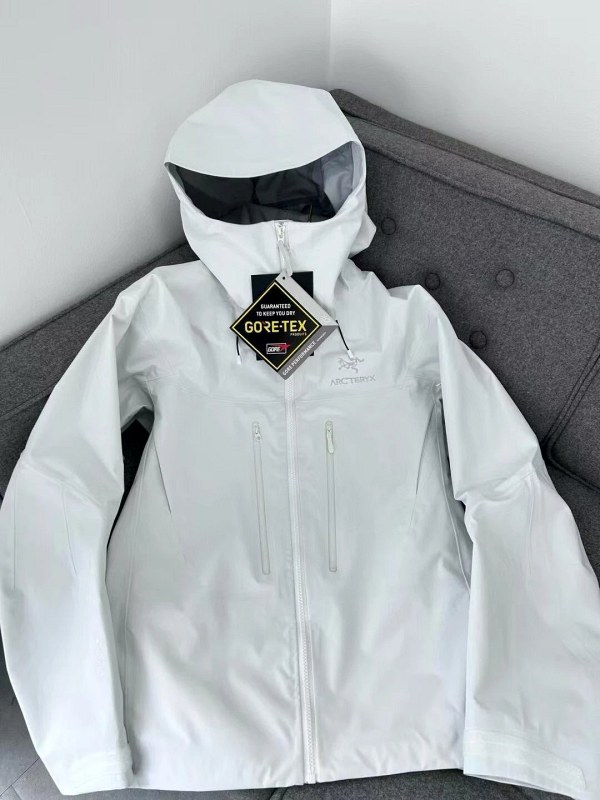
A light, streamlined white hardshell at $137.31 that beads water and layers cleanly over a fleece — but ten days of city wear left the cuffs grey, and the listing still hides its membrane spec.
- Hands-on score
- 4.0 / 5
Editor verdict
A capable, light white shell at a shopping-agent price: it beaded water, taped its seams and layered well over a fleece. The colorway shows every scuff, and the seller never states fabric, membrane or measurements.
What works
- Seam taping, storm flap and water-resistant chest zips handled drizzle and lakefront wind.
- Light on our bench at 468 g in size M, with a hood that adjusts without collapsing.
- Layers cleanly over a 200-weight fleece without a boxy cut.
Watch-outs
- White finish picked up grey scuffs at cuffs, collar and bag-strap contact in ten days.
- Listing omits membrane spec, flat measurements and any condition record.
- Owners of light Arc'teryx shells widely report yellowing over time.
Anyone wanting a light, clean-looking technical shell for commuting, travel and city rain, who will spot-clean white fabric and confirm measurements with the seller first.
Trail-first buyers who need a documented membrane spec before paying, or anyone who wants a low-maintenance shell that hides dirt — a darker colorway is the easier choice.
Editor score 4.0 / 5
By Priya Raghavan, Reviews Editor
We ordered the Arc'teryx White Waterproof Hard-Shell Jacket in size M through a buying agent, photographed the parcel before it was opened, and put the jacket straight into our ten-day rotation: 20 km of Chicago pavement, two wash-and-dry cycles, and a full bench pass with the caliper, the spray bottle and the seam loupe. What our testing team found is a genuinely usable light shell wrapped in a colorway that charges you rent.
Order, arrival and what the listing does and does not say
The catalog entry is SKU 7702033467 at $137.31 against a $154.90 list price, listed in stock across S–XXL. Order-to-door ran 12 days. The listing names the colorway and the size run and very little else: no fabric or membrane specification, no flat measurements, no condition record. That is not a small gap on a hardshell, where the membrane is the product. We confirmed what we could at the bench and flag the rest as unconfirmed below.
Construction: seams, zips and the GORE-TEX tag
The streamlined silhouette described in the listing holds up in the hand. The high collar stands on its own, the attached hood has a wire brim and two rear adjusters, and the dark lining visible at the hood opening is a soft tricot rather than a bare coating.
- Seam tape: 13 mm tape across the shoulder and hood seams, 10 mm at the side seams. Laid flat in every section we checked, with no lifted edges after two washes.
- Front closure: full-length zip with an internal storm flap behind it. The GORE-TEX tag is stitched to the front zipper, exactly as pictured in the listing.
- Chest pockets: two vertical pockets with water-resistant zips and roughly 14 cm openings — long enough for a phone, angled so a bag strap does not sit on top of them.
- Stitching: 8–9 stitches per inch at the shoulder seams under the 10x loupe, even tension, no loose thread ends. Cuff hems are cleanly turned.
Wind and water: what ten days actually tested
On the bench, a spray bottle produced tight beading across the shoulders and hood that held for well over a minute before any darkening. On the street, the jacket shrugged off a 15-minute drizzle and a lakefront headwind without wet-out at the shoulders or a wind-chill bite through the front zip. This is not a storm test — we did not get a sustained downpour in the window, and no ten-day test substitutes for a season.
After the second machine wash on a technical cycle, beading dulled noticeably at the cuffs and the hood brim until a low tumble dry revived most of it. That is normal DWR behavior, not a defect, but it tells you the finish will need periodic heat reactivation.
Fit and layering
| Bench check (size M) | Measured |
|---|---|
| Weight | 468 g |
| Center-back length, collar base to hem | 72 cm |
| Chest, pit to pit, flat | 58 cm |
| Sleeve, shoulder seam to cuff | 64 cm |
| Collar height at center front | 9 cm |
| Shoulder seam tape width | 13 mm |
We recorded internal length at three positions — center back, underarm and sleeve — and then layered a 200-weight fleece underneath. The size M took the fleece with room at the chest and no restriction reaching overhead; a heavier puffy would bind at the upper back. The cut is close through the body and long in the sleeve, which suits a mid-layer system rather than a sweatshirt-and-go fit.
Arc'teryx's own sizing guidance is the useful reference here: its fit was recently revised, with smaller sizes tighter and larger sizes looser, and the brand advises taking the larger size between sizes for a looser fit. Owner threads echo it — most people size up when they plan to layer under a hard shell. Treat the listing's S–XXL run as labels, not measurements, and ask for the flat numbers first.
The white colorway is the real trade-off
Twenty kilometers of city wear left three marks we could not ignore: a grey smudge along both cuffs, a faint dark line at the collar edge where it met a beard and a scarf, and a scuff patch on the right shoulder where a bag strap rubbed. All three came out with a damp cloth and a mild soap, but each needed attention. None of it is specific to this jacket; it is what white fabric does.
"It's a great choice if you're into yellowing, staining, and being unable to be rescued if you're hidden by snow. I would stay away from it." — Arc'teryx owner on light hardshell colorways
Owner reports on white and other bright Arc'teryx shells are consistent about yellowing and staining over time and about light colors being harder to clean than dark ones. Separately, some hard-shell owners report delamination after comparatively light use. That second point is a category-level concern from owner threads, not a finding about our unit — our jacket showed no bubbling or tape lift in ten days, and ten days is not enough to speak to a season of use.
Price, value and the questions left open
At $137.31, the jacket undercuts what a technical shell usually costs and behaves like a real one at the seams, zips and hood. The honest caveats are the finish and the paperwork. The listing does not state fabric or membrane specification, does not provide flat measurements, and carries no condition record, so our water and wind results confirm the shell beads and blocks wind without confirming which membrane is inside.
Before ordering, ask the seller for flat measurements across the chest and center back, the fabric and membrane name, close-ups of the shoulder seam tape and the front zip, and a clear statement of condition. If those answers come back specific, the jacket is a sensible buy for city rain and travel. If they do not, the white colorway is a lot of maintenance to take on faith.