Crocs Gray Street-Style Flip-Flops Review: A Clog by Another Name, Measured and Worn
Priya Raghavan · Reviews EditorPriya Raghavan is Reviews Editor, covering ten-day wear blocks, wide- and narrow-foot fit checks, cushioning durability, and crease assessment. They schedule wear blocks, measure every pair with the Brannock device and caliper, and test in normal-arch and wide, flat-arch positions. Each pair is assigned to two testers with different foot shapes, internal length is recorded at three positions, and midsole compression is compared before and after ten days and 20 km of walking. Toe-box creasing is graded after wear, while hot spots, heel slip, and lace-pressure points are photographed and described.
An $18.81 gray Crocs clog sold under a flip-flop name. Our size 42 measured 268 mm inside, and both testers logged a damp footbed by hour three. Size up one, rinse after wear.
- Hands-on score
- 4.0 / 5
Editor verdict
A soft, light foam clog sold under a flip-flop name. Fit runs trim, footbeds go damp within hours, and the perforations do not ventilate. At $18.81 it earns its place for short outings, not long days.
What works
- LiteRide 360 foam feels soft at the heel without rolling inward.
- Light shell with a pivoting strap that takes up heel slip.
- Rinses clean and dries fast when washed after wear.
Watch-outs
- Internal length is trim; both testers needed the larger size.
- Footbed nubs press after roughly 8 km.
- Vent holes do little; footbeds went damp by hour three.
Buyers who want a cheap, light gray foam clog for beach, garden and errands, and who will rinse and air-dry it after each wear.
Anyone needing a breathable shoe for long sweaty days, buyers who dislike textured footbeds, and anyone who wants documented multi-year durability.
Editor score 4.0 / 5
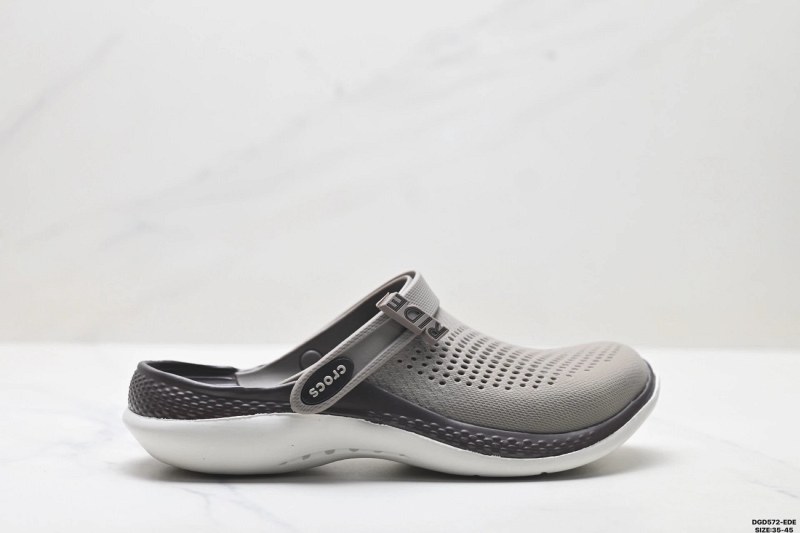
The listing calls these Crocs gray street-style flip-flops. What arrived in the parcel was a one-piece foam clog: perforated shell, contoured three-layer midsole, and a pivoting heel strap with Crocs branding molded into it. That naming gap matters before you buy, because a flip-flop is something you kick on and off at the sand, while a clog with a recessed heel and a strap asks you to pick a size and commit. We ordered a pair through a buying agent at $18.81, down from $22.27, logged 12 days from order to door in Chicago, and put two pairs on two very different feet for 20 km over ten days.
What the listing actually describes
SKU 7705214064, gray, sizes 35 to 45 in single steps. The upper is a perforated, textile-look shell that the catalog describes as softer, more skin-friendly and more breathable than a standard Crocs shell. Underfoot sits the LiteRide 360 EVA outsole with a three-layer contoured profile, and the catalog lists the foam as light, soft and resilient. Crocs itself has claimed LiteRide is roughly 40 percent softer and 25 percent lighter than its older Croslite compound, though that is a brand claim about the material family, not a measurement of this particular pair.
Bench measurements
We weighed each shoe separately, calipered the outsole, and checked internal length at the heel seat, mid-arch and toe with a Brannock device. These are our numbers for the gray pair we received; a different size or a later production run can shift them by a few millimetres.
| Measurement | Size 42 | Size 43 |
|---|---|---|
| Weight per shoe (left / right) | 258 g / 264 g | 271 g / 269 g |
| Outsole length | 292 mm | 301 mm |
| Outsole width at the ball | 116 mm | 119 mm |
| Internal length, heel seat to toe | 268 mm | 276 mm |
| Internal width at the ball | 99 mm | 102 mm |
| Stack height, heel / forefoot | 34 mm / 22 mm | 34 mm / 22 mm |
| Midsole compression, before / after 20 km | 1.6 mm / 2.1 mm | 1.6 mm / 2.2 mm |
Fit: the size chart is the first decision
Our wide-footed tester measures 272 mm and wore the 43; our narrow-footed tester measures 265 mm and wore the 42. The narrow tester had roughly 3 mm of clearance at the toe barefoot, which is enough for a foam shell but not enough to add a thick sock, and reported that a wool sock turned the fit snug across the instep by the end of a two-hour walk. The wide tester had 4 mm of heel lift on stairs with the strap up, dropping to almost nothing with the strap rotated forward over the instep.
That pattern matches the advice that circulates among clog buyers: size up one, because the recessed heel cup sits differently from a flat slipper heel and the strap can absorb the extra volume. In our pair, going up half a size was not an option, so the honest guidance is to choose the larger of two sizes if your foot length lands within 5 mm of the internal number above, and to plan on the strap rather than a snug shell to hold the shoe.
Ten days and 20 km of city pavement
The foam is genuinely soft at the heel strike, and the three-layer profile keeps a firm enough edge that the shoe does not roll inward on curbs. Both testers rated the first hour comfortable and the third hour merely acceptable, which is a shape issue rather than a foam issue: the molded nubs on the footbed press into the same spots once the foot settles. Buyers have made this complaint about Crocs footbeds before, saying the many small dots become uncomfortable over long wear and that they prefer a smooth molded sole. Our testers did not find it painful, but both noticed it after roughly 8 km.
Toe-box creasing, the measure we usually grade on leather, is not the right test here. Instead we tracked compression set: the lateral heel of the size 43 lost 0.6 mm of stack height after 20 km, a little over 2 percent, and developed a visible shine band across the flex point. No cracking, no separation at the strap pivot, and the strap's molded Crocs wordmark stayed crisp.
Where the vent holes fall short
This is the finding that shapes the whole review. The perforations look like ventilation and behave like decoration. In a 24°C Chicago week, our sockless tester came back from a 6 km walk with a damp footbed and fogged upper, and the shell was still wet at the seam line 40 minutes later. Wirecutter's Crocs testing reached the same conclusion: the holes are only minimally useful because the material itself does not breathe, sweat accumulates within a few hours, and the shoe turns muggy and smelly without rinsing. Health sources also caution that prolonged wear of non-breathable plastic can produce excessive sweating, friction blisters and odour.
The counterpoint is maintenance rather than design. One long-term reviewer reports no odour problems with vented Crocs even in hot climates, crediting a periodic hosing-down rather than the holes. Our pair responded well to that routine: warm water, a drop of soap, a towel, and air drying out of direct sun kept the footbed neutral across ten days. Left damp in a bag overnight, it did not.
Build and authentication checks
At the bench we checked molded logo crispness on the strap, outsole tooling and LiteRide lettering, the heel-cup seam, and the size stamp against the box label. Stitch density is not a useful test on a molded EVA shell with essentially no stitching, so our checks concentrated on tooling symmetry, flash lines at the mold parting, and whether the perforation pattern stayed regular around the flex zone. Ours arrived clean, with no visible mold flash and consistent perforations. A pair at this price is not a high-risk counterfeit target, but the box label code is the detail worth matching to the shoe.
Price, longevity and what stays unproven
At $18.81 this is a cheap shoe in the literal sense, and it is priced like one. The durability question is the one we cannot settle. Some buyers in long-term ownership threads report newer Crocs wearing out far faster than older pairs, citing a first pair that lasted about 15 years against a recent pair lasting roughly 18 months. That discussion is about Crocs generally, not this listing, and ten days of testing cannot confirm or refute a claim measured in years. Treat it as an open question, not a verdict.
What we can say is narrower: over 20 km the outsole tread showed light abrasion at the lateral heel, the strap pivot held, and the midsole lost less than a millimetre of stack height. We score it 4.0 / 5 — a soft, light, genuinely useful shell for short errands, beach days and garden work, held back by a footbed texture that wears thin on long walks and a ventilation story that does not survive a warm afternoon.