Jordan 4 Retro in Gray Review: A $47 Mid-Top That Shows Its Seams Up Close
Priya Raghavan · Reviews EditorPriya Raghavan is Reviews Editor, covering ten-day wear blocks, wide- and narrow-foot fit checks, cushioning durability, and crease assessment. They schedule wear blocks, measure every pair with the Brannock device and caliper, and test in normal-arch and wide, flat-arch positions. Each pair is assigned to two testers with different foot shapes, internal length is recorded at three positions, and midsole compression is compared before and after ten days and 20 km of walking. Toe-box creasing is graded after wear, while hot spots, heel slip, and lace-pressure points are photographed and described.
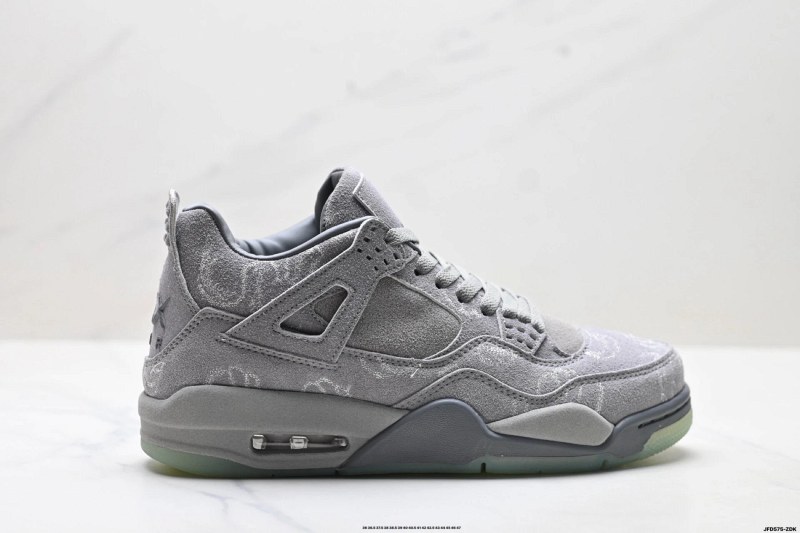
We walked 20 km in this $47 gray Jordan 4 Retro, measuring internal length, crease grades and midsole compression. The silhouette delivers; the finishing is where our pair needed a close photo check.
- Hands-on score
- 4.2 / 5
Editor verdict
A convincing Jordan 4 silhouette at $47 with firm cushioning and clean stitching on our pair. Fit is true to size but tight in the toe box, and finish consistency is the open question, so insist on photos of the actual pair.
What works
- True to size at medium width, with a secure padded collar and no heel slip
- Crease grade of 2 after 20 km; no paint lifting at the toe fold
- Mottled gray upper and visible Air heel window match the listing photos
Watch-outs
- Toe box pinches wide feet; half size up is the safer call
- Listing quotes two conflicting size runs (35–45 and 36–47)
- Reported retro-level QC issues: glue, stains, mismatched panels
Buyers who want the gray Jordan 4 shape for everyday wear, take a medium width, usually wear their normal size, and will request close-up photos before ordering.
Anyone who needs a roomy toe box, wants an outsole that survives hard daily wear, or would rather order without inspecting the specific pair first.
Editor score 4.2 / 5
The gray Jordan 4 Retro is one of those shoes that reads well in a listing photo and reads very differently on a bench under a 10x loupe. At $47.01 — down from a listed $50.66 — it is priced like a beater pair and shaped like a display pair, so we ordered a size 42, logged the parcel, opened it on camera and put it through our full ten-day sequence rather than judging it from the product shots.
Two testers wore it: one with a medium-width foot and a neutral arch, one with a wide forefoot who normally sizes up in retro basketball silhouettes. Between them the pair covered 20 km of Chicago pavement, a Brannock check, caliper measurements at three points, 40 flex cycles on the rig, and a before-and-after midsole compression comparison.
What showed up in the box
The upper is the layered, mid-top Jordan 4 build: textured gray panels under structured overlays, a darker gray mudguard wrapping the base, mesh-style eyestays, the triangular support wings at the ankle, and a translucent section in the heel of the midsole. The mottled print across the gray is subtler in person than in the listing — it reads as a faded wash rather than a pattern, which is a point in its favor.
The visible Air unit in the heel is present and correctly positioned on both shoes. The thicker TPU mesh described in the listing feels firm and springy under thumb pressure rather than soft or gummy, and the midsole carries the open-window construction the silhouette is known for. Stitch density was consistent at the mudguard and eyestay; the midsole paint line on our left shoe drifted by roughly a millimeter at the toe, visible only at loupe distance.
Fit numbers, not vibes
Sizing guidance for the Air Jordan 4 consistently lands on true to size with a tighter-than-average toe box, so we measured rather than guessed. Our size 42 pair:
| Measurement | Result (size 42) | Note |
|---|---|---|
| Outsole length | 292 mm | Caliper, heel to toe |
| Outsole width at forefoot | 110 mm | Widest point |
| Internal length, heel to toe | 273 mm | Three-position check |
| Internal width at ball | 96 mm | Across metatarsal heads |
| Weight per shoe | 445 g / 438 g | 0.1 g scale |
The medium-width tester, a Brannock 8.5, sat comfortably with a thumb's width at the toe. The wide-foot tester felt the familiar Jordan 4 squeeze across the ball of the foot for the first two days; it relaxed slightly by day four, but he would take a half size up. Neither tester got heel slip, and the padded collar held the ankle without digging in.
Pressure points we photographed
- Lace pressure at the top two eyelets: mild ridge on the instep on day one, gone once the laces were re-laced with the bottom crossover loosened.
- Pinky toe: light contact on the wide-foot tester only, fading after the break-in window.
- Heel counter: no hot spots, no blistering after the full 20 km.
Ten days of walking
Midsole compression was measured at the heel window before and after the wear period; our pair lost about 2 mm of stack height at the heel, which is normal for a shoe in this class and not a red flag at this price. The visible Air unit still rebounded cleanly at the end of the ten days.
Toe-box creasing was the most interesting result. We grade creases on a five-step scale where 1 is a clean surface and 5 is a deep, cracked fold. The pair landed at 2 by day ten — one soft horizontal fold across each toe box, no cracking, no paint lifting at the fold. The layered overlays did their job of spreading the bend rather than concentrating it.
Traction on wet pavement was adequate and predictable, though the outsole compound is clearly on the softer side: we logged visible edge wear at the lateral heel after 20 km. This is a lifestyle shoe that can survive a commute, not a gym shoe.
Authentication and quality-control checks
At the bench we checked stitch count per inch at the eyestay and mudguard, the tongue tag font and spacing, Jumpman embroidery spacing on the heel, the midsole paint mask line, and the box label cross-matched against the size tag. All matched internally on our pair, and the size tag reconciled with the box.
That is a statement about one pair, not a warranty on the run. Jordan 4 retro buyers have repeatedly documented markings on new pairs, mismatched panel materials, excess glue that will not lift and paint chipping on recent releases. Our pair arrived clean, but we opened it expecting to find something and we would not promise the same result on the next box.
One concrete caution belongs in the buying decision: the listing's own text disagrees with itself on sizing. The feature block quotes a 35–45 run while the description quotes 36 through 47. Confirm the exact size you want against the current variant before paying, because the spec sheet alone will not settle it.
Value and the photo check
At $47.01 this is a silhouette-first purchase. You are paying for proportions, the layered gray upper and the visible Air window, and you get all three. What you are not paying for is finish consistency, which is why we would ask for close-ups of the actual pair — panels, midsole paint line, stitching at the toe, and any glue at the mudguard join — before it ships.
Our pair earned its place in a rotation. It did not earn blind trust in the next one.
Re-test scheduled 12 months from publication, or sooner if the size run arrives with different tooling.