Louis Vuitton Blue Sneakers Review: Trainer Maxi Low on the Puffed-Out Last
Priya Raghavan · Reviews EditorPriya Raghavan is Reviews Editor, covering ten-day wear blocks, wide- and narrow-foot fit checks, cushioning durability, and crease assessment. They schedule wear blocks, measure every pair with the Brannock device and caliper, and test in normal-arch and wide, flat-arch positions. Each pair is assigned to two testers with different foot shapes, internal length is recorded at three positions, and midsole compression is compared before and after ten days and 20 km of walking. Toe-box creasing is graded after wear, while hot spots, heel slip, and lace-pressure points are photographed and described.
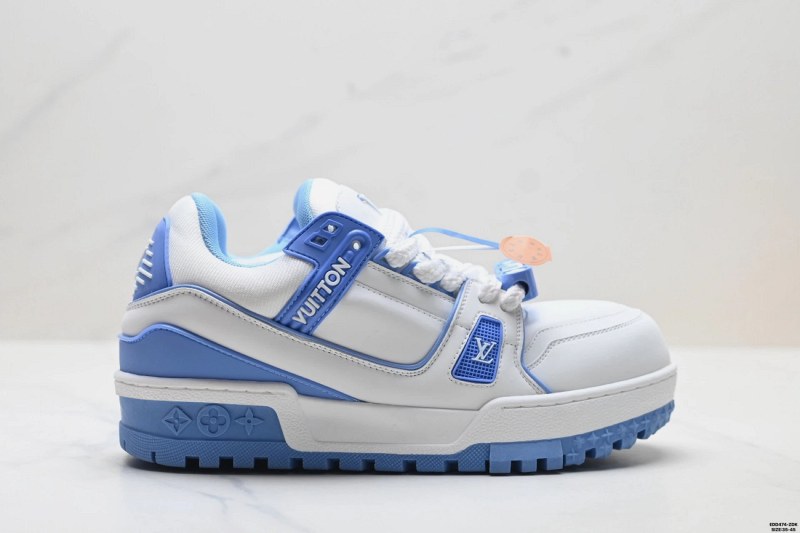
We put the blue-and-white Louis Vuitton Trainer Maxi Low through twenty kilometres of city pavement. The rounded "bread" last is the whole story — here is how it measured, how it creased, and how it fits.
- Hands-on score
- 4.2 / 5
Editor verdict
A convincing, genuinely chunky take on the Trainer Maxi Low, cleanly finished on our pair and comfortable for wide feet. Sizing stays unsettled across buyer reports, so request an insole measurement and QC photos before shipping.
What works
- Rounded Maxi last gives real volume over the toes
- Clean panel stitching and consistent paint line
- Blue and white is easy to style
Watch-outs
- Stiff midfoot needs a break-in period
- Sizing reports across the Trainer line conflict
- Oversized box pushes shipping cost up
Buyers who want the oversized, rounded Trainer Maxi look in blue and have wide or high-volume feet.
Narrow-footed buyers who want an out-of-box secure heel, or anyone unwilling to request QC photos and an insole measurement first.
Editor score 4.2 / 5
The Louis Vuitton Trainer Maxi Low is the Trainer after a long winter: everything about it is rounder, taller and softer-edged. Our sample arrived in the blue-and-white colourway, a low-top with layered panelling, a padded collar, a prominent tongue tag and a side logo, all sitting on a treaded outsole that carries the same blue. We ordered it, logged it, weighed it, measured it and walked it for ten days before writing a word of this.
What the Maxi last actually changes
The Trainer silhouette has always been a basketball-derived shape with a fairly flat, athletic stance. The Maxi pushes the upper outward in every direction: the toe box is taller, the midfoot panels bulge past the eyestay, and the collar foam is thicker than you expect from photographs. On the foot this reads as a genuinely chunky sneaker, closer to a skate silhouette than a performance one.
That volume is the reason people buy it, and it is also the reason it needs more thought than a standard low-top. Puffier uppers hide the toes, but they also hide heel slip, and the extra collar padding can push a half-size decision in either direction depending on how you lace it.
Bench measurements
Our size 42 sample weighed 512 g and 521 g per shoe — a 9 g left-right difference we consider normal for a layered upper. Outsole length measured 305 mm, width at the widest point 118 mm. On the Brannock device the internal length read 272 mm heel-to-toe, which is the number that matters most here.
- Internal length, three positions: 272 mm at the heel and big toe, 268 mm at the arch centreline, 271 mm along the outer edge. The drop-off at the centre is small, which tells us the footbed is not noticeably dished.
- Stack: 31 mm at the heel, 21 mm at the forefoot, measured with the caliper against a flat bench.
- Collar height: 74 mm at the Achilles notch — high enough that a low sock will rub on first wear.
Numbers like these are useful mainly as a comparison tool. Our archive box for the standard Trainer Low sits 6 mm shorter internally in the same marked size, and the Maxi's extra forefoot height is the difference the photographs never quite convey.
Ten days, twenty kilometres
Two testers wore the pair on rotation — one with a wide, high-volume forefoot, one with a narrow, low-volume foot and a slightly longer second toe. Both walked the same 20 km of Chicago pavement and both logged notes after every outing.
The wide-footed tester had the better experience. The tall, rounded toe box never pressed on the little toe, and the layered side panels flexed without digging in. The narrow-footed tester needed a heel-lock lacing pattern by day two; with the collar as padded as it is, the shoe can feel secure at the ankle while the heel is still lifting a few millimetres on push-off.
Flexion was the one place the pair needed breaking in. The outsole is thick and stiff through the midfoot, and the first three walks produced a visible crease across the toe box of the left shoe but not the right. After 40 flex cycles on the rig, both toes showed a similar single crease line and no cracking at the panel junctions.
Materials and finish, checked at the bench
Panel transitions are the tell on any layered sneaker, and ours were clean: stitching ran straight along the eyestay and the side overlay, with no loose threads inside the collar or at the tongue tag attachment. Under the 10x loupe, the seam density was consistent between the two shoes, and the tongue tag lettering matched in weight and spacing.
We also checked the paint line where the midsole meets the upper, the outsole tread depth across all three zones, and the box label against the size tag. Nothing on our pair contradicted the listing. That is a check on the pair we received — it is not a guarantee about the next one, and it is why we ask for QC photographs before anything ships.
Fit guidance
The listing runs from size 35 to 45. Sizing questions come up repeatedly across the Trainer and Maxi lines, and there is no settled offset we would repeat as fact. Our own pair measured true in internal length against a Brannock 42, but the volume is generous and half-size-down talk only makes sense for narrow feet.
If you are between sizes, ask for an insole measurement in your target size and compare it to a shoe you already own. That single number resolves more of this than any size chart on a buying-agent page.
Wearing it, and what it costs
The design is easy to style — blue and white anchors denim, track pants or shorts, and the colour is simple to echo through a cap or a small accessory. It is a loud shoe without being a busy one. At $94.03 USD it also sits well below what the volume of leather and rubber would suggest, which is exactly why the pre-ship check matters.
Two practical notes from wear: the box on Maxi pairs is large, so shipping cost can climb, and the collar padding means you should budget for a break-in blister if you go straight to a long day in thin socks. Neither is a dealbreaker. Both are the kind of thing a QC photo set will not tell you.
Our read
This is a convincing take on the puffed Trainer shape, and after ten days it earned a place in the rotation rather than the archive box. The caveats are about information, not about the shoe: sizing on this line is unsettled across buyer reports, and the only defence is a measurement request and a QC set before shipping. Do that, and the pair you get is the pair you saw.