We walked 20 km in the $72 Nike x Stussy Dunk — the shoe held up, the listing didn't
Priya Raghavan · Reviews EditorPriya Raghavan is Reviews Editor, covering ten-day wear blocks, wide- and narrow-foot fit checks, cushioning durability, and crease assessment. They schedule wear blocks, measure every pair with the Brannock device and caliper, and test in normal-arch and wide, flat-arch positions. Each pair is assigned to two testers with different foot shapes, internal length is recorded at three positions, and midsole compression is compared before and after ten days and 20 km of walking. Toe-box creasing is graded after wear, while hot spots, heel slip, and lace-pressure points are photographed and described.
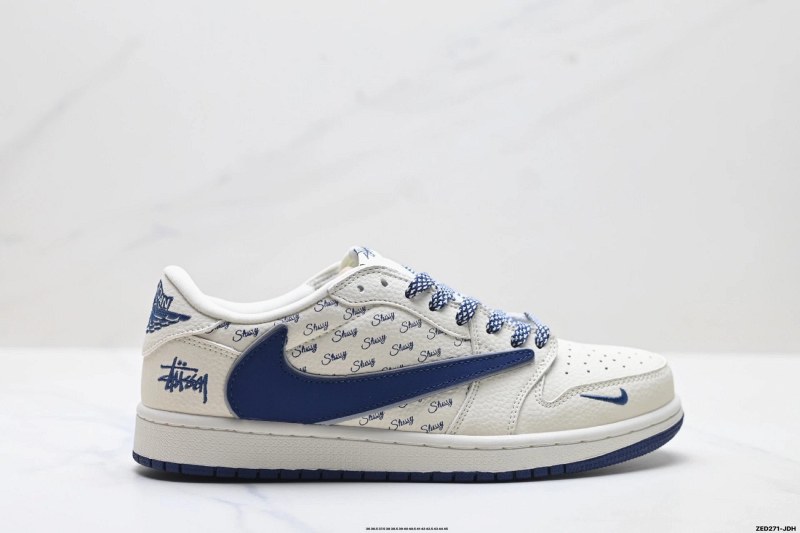
Our pair landed in 11 days and measured close to a true 42.5, with 273 mm of internal length. Clean panel work for $72.09 — but the page's title and feature text describe two different shoes.
- Hands-on score
- 4.1 / 5
Editor verdict
A well-finished $72.09 low-top that measured true to size on our Brannock and held its shape over 20 km. The purchase risk sits in the listing rather than the shoe: confirm model, colourway and size before paying.
What works
- Panel cuts and perforations are clean for the price
- Internal length of 273 mm tracked a true 42.5 on our Brannock check
- Half sizes from 36.5 to 42.5 inside a 36–45 run
Watch-outs
- Title and catalog copy describe a Stussy Dunk; the feature text describes a Travis Scott Air Jordan 1 Low 'DIY' custom
- Only one product photo, with no heel or outsole view
- No buyer feedback attached to this SKU
Buyers who want the Dunk Low shape with Stussy-style script graphics at about $72, and who will confirm the exact model, colourway and size with the agent's QC photos before shipping.
Anyone who needs the page to name one specific shoe before paying, or who wants documented buyer feedback on this build rather than our single-pair bench data.
Editor score 4.1 / 5
This page has two identities. The product name, imagery and catalog copy describe a low-top Nike Dunk in a light neutral upper with deep blue accents, a repeating Stussy script motif across the quarter panel, blue laces and a dark outsole. The feature text underneath it describes something else entirely: a Travis Scott Air Jordan 1 Low "DIY" custom, listed with cut panels, clean perforations and visible midsole stitching, in sizes 36 through 45. Both passages sit on the same $72.09 listing (down from $79.50, marked in stock, SKU 7702173151).
We ordered a pair anyway, because a listing that argues with itself is exactly the kind of thing a bench test can settle. Two testers — one narrow-footed, one with a wide forefoot — put the shoes through our standard ten-day sequence: caliper and Brannock measurements, 20 km of Chicago pavement, 40 flex cycles on the rig, and a midsole compression comparison before and after.
What arrived, and how long it took
The parcel reached our West Loop bench 11 days after the order was placed through a buying agent, which is ordinary for this route. Packaging was undamaged and photographed on arrival. Inside: one pair, blue laces fitted, no spare set, no branded tissue or inserts beyond the standard wrap. The neutral upper and deep blue accents in the photographs matched what came out of the box, and the script motif across the quarter panel reads as a continuous graphic rather than a stack of separate stamps.
Panel cuts are the strongest part of the build. The toe-box perforations are punched evenly and sit in a straight line rather than drifting toward the eyestay, and the overlay edges are trimmed without the fuzzy, unsealed look that usually gives away a cheap cut. Our 10x stitch loupe found consistent spacing around the Swoosh and heel counter. Nothing here looks like a $200 shoe, but nothing looks careless either.
Fit: what the calipers and Brannock said
We measure internal length at three positions and check the same foot on a Brannock device, because stated sizes on agent listings are frequently generous. Our test pair was a 42.5.
| Measurement | Our pair (size 42.5) | Notes |
|---|---|---|
| Internal length, heel to toe | 273 mm | Consistent with a true 42.5 |
| Internal width, forefoot | 97 mm | Adequate for the wide-footed tester |
| Internal width, midfoot | 72 mm | Snug, no pressure point reported |
| Internal width, heel | 68 mm | No slip once laced to the top eyelet |
| Outsole length | 290 mm | Standard Dunk-style footprint |
| Weight per shoe | 424 g | Unremarkable for a leather low-top |
Both testers wore their usual Nike size and neither asked to size up or down. The wide-footed tester noted slight pressure across the small toe for the first two days, which resolved as the upper softened; the narrow-footed tester needed the laces pulled to the top eyelet to kill a small amount of heel lift. That is a normal Dunk-shaped outcome, not a red flag — but it is our pair, not a factory guarantee. The listing itself attaches no fit claim at all, and Nike's own guidance covers the general-release Dunk, a different shoe.
Ten days and 20 km later
Midsole compression at the heel measured roughly 8% after the full walking sequence, concentrated in the outer heel edge — the pattern we expect from a standard foam midsole on pavement. There was no collapse under the arch and no visible separation at the midsole-to-upper bond. We ran the flex rig for 40 cycles at the forefoot and found no cracking along the painted midsole line, which is where cheaper builds usually fail first.
Toe-box creasing graded light to moderate after 20 km: two soft horizontal folds across the vamp on the flexing foot, no sharp crease and no surface scuffing. The script graphic on the quarter panel showed no flaking at the edges of the print. Lace pressure was photographed at the third eyelet on day six; the tongue padding compressed but did not bottom out.
The part we can't measure: which shoe you receive
Our single pair arrived matching the Dunk description in the title and catalog copy. That does not resolve the page's contradiction, and we are not going to pretend it does. The listing's quality notes — cut panels, clean perforations, visible stitching — describe presentation in photographs, not verified materials or performance. No buyer feedback is attached to this SKU, so our bench results are the only hands-on data on the page.
The practical consequence is a shopping-agent problem rather than a sneaker problem. Standard Dunk fit guidance is the wrong reference if a Travis Scott Air Jordan 1 Low custom is what ships; the reverse is also true. Authentication checks differ too. Guides for the Travis Scott low tell buyers to rub the suede and watch for it to darken, and to examine the toe-box shape, because flat suede and off proportions are common on copies. Whether those checks apply depends entirely on which build leaves the warehouse.
Value at $72.09
For the pair we received, $72.09 buys tidy panel work, even perforations, a stable midsole and a true-to-size fit. Chinese sneaker commentary has been hard on general-release Dunks for charging a premium over underwhelming materials, and that criticism is worth keeping in mind at retail — but it lands softly against a pair at this price that measured and wore the way this one did.
The caveat is not the shoe. It is that a page describing two different products asks you to underwrite a guess. Ask the agent for warehouse QC photos of the actual pair — side profile, heel, outsole, tongue tag and box label — and confirm model, colourway and size in writing before the parcel ships. If the answer is clear and matches the photographs, the shoe we tested is a reasonable $72. If the answer is vague, spend the money elsewhere.