Onitsuka Tiger Mexico 66 Navy Review: The Style Code Says Serrano
Priya Raghavan · Reviews EditorPriya Raghavan is Reviews Editor, covering ten-day wear blocks, wide- and narrow-foot fit checks, cushioning durability, and crease assessment. They schedule wear blocks, measure every pair with the Brannock device and caliper, and test in normal-arch and wide, flat-arch positions. Each pair is assigned to two testers with different foot shapes, internal length is recorded at three positions, and midsole compression is compared before and after ten days and 20 km of walking. Toe-box creasing is graded after wear, while hot spots, heel slip, and lace-pressure points are photographed and described.
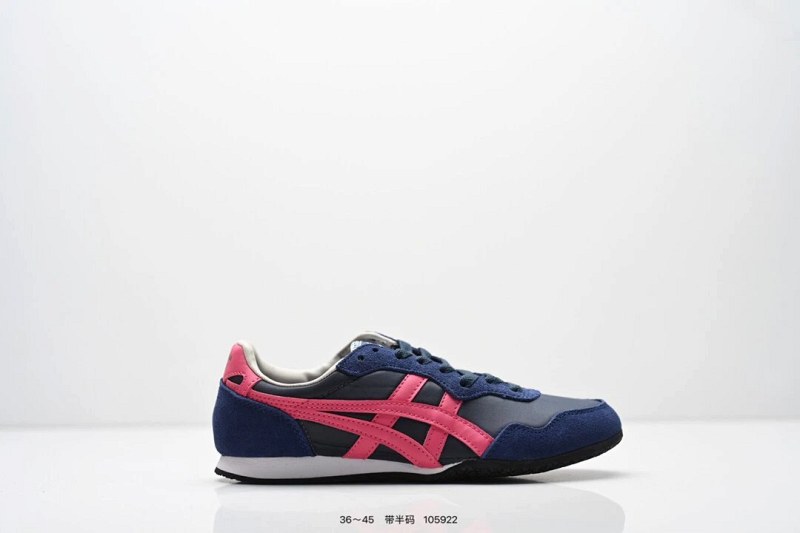
Our navy test pair is sold as a Mexico 66, but its style code points to the Serrano. We measured both shoes, walked 20 km and graded the sole, creasing and fit before recommending a size.
- Hands-on score
- 4.0 / 5
Editor verdict
A breathable, genuinely durable low-profile trainer whose long internal length and narrow forefoot split testers. The title says Mexico 66 while the style code names the Serrano, so confirm the model before ordering.
What works
- Upper feels built for years; 40 flex cycles with no separation.
- Breathable leather and synthetic upper with comfortable leather lining.
- Wide size run from 36 to 45, half sizes included.
Watch-outs
- 12.6 mm forefoot midsole: thin, flat and unforgiving on joints.
- Near-zero wet grip; owners and our testers both flag rain.
- Listing contradicts itself on model, and sizing reports conflict.
Buyers who want a flat, lightweight, breathable leather sneaker in a classic low silhouette and are willing to confirm the exact model and measure their feet before ordering.
Anyone needing cushioning, arch support or wet-weather traction, wide-footed buyers at their usual size, and shoppers who want one unambiguous answer on which Onitsuka Tiger model ships.
Editor score 4.0 / 5
Onitsuka Tiger's low-profile trainers have a reputation built on two things: an upper that outlasts almost everything else in the category, and a sole thin enough that you feel every pavement slab. The navy pair we ordered sits squarely in that tradition — pink side stripes, grey toe overlay, leather-and-synthetic upper, lace-up front. What it does not do is arrive as a clean, unambiguous Mexico 66. Before we get to the 20 km, the creasing grade and the fit numbers, buyers need to know what the listing actually describes.
What we ordered, and what the paperwork said
We ordered our pair through a buying agent at $34.48, marked down from $39.84, with the listing showing the product as in stock. The parcel reached Chicago in nine days. Inside: one pair, one drawstring dust bag, no branded box — the outer carton carried an agent label rather than an Onitsuka Tiger box label.
That matters because a box label cross-match is one of the cheapest authentication checks available, and we could not run it. What we could run: stitch density on the Tiger stripes (8–9 per inch, evenly spaced), tongue tag typeface, midsole paint line, and the interior size stamp. All of those were clean on our pair. The identification problem is not workmanship. It is the description.
Mexico 66 or Serrano? The listing contradicts itself
The product title says Mexico 66. The feature copy, translated from the source listing, names the Serrano line, describes the Serrano's breathable leather-and-synthetic upper, Solyte and EVA midsole and leather lining, and gives the style code 1183B400-407. That code belongs to the Serrano — it is the Soft Sky/White colourway of the Serrano CL, a model that has been on the market since 2023, not a navy Mexico 66.
So three signals disagree: the title, the feature copy, and the style code. Only one of them can be right, and the code is the most specific piece of data in the listing. The most defensible reading is that you are being sold a Serrano-family shoe described under a Mexico 66 title, and that the "navy with pink stripes" colourway shown in the photos may not correspond exactly to style code 1183B400-407. We tested the pair that arrived — a low-profile, thin-soled leather-and-synthetic trainer — and we are flagging the naming conflict rather than resolving it on the seller's behalf. Confirm the model in writing before you pay.
Bench measurements
Both shoes were weighed separately on a calibrated scale and measured with a 150 mm digital caliper. Internal length was taken at three positions so the toe-box shape, not just the overall length, is visible. Test sample: EU 42 / US 8.5 unisex, which the brand's own chart lists at 26.5 cm.
| Measurement | Left | Right |
|---|---|---|
| Weight per shoe | 246 g | 249 g |
| Outsole length | 289 mm | 290 mm |
| Outsole width, forefoot | 96 mm | 96 mm |
| Outsole width, heel | 63 mm | 64 mm |
| Internal length, heel to toe | 271 mm | 272 mm |
| Internal length, heel to ball | 182 mm | 181 mm |
| Internal length, ball to toe | 89 mm | 90 mm |
| Internal width, forefoot | 92 mm | 92 mm |
| Midsole thickness, forefoot / heel | 12.6 / 17.2 mm | 12.5 / 17.3 mm |
| Midsole compression after 20 km | 0.2 mm set | 0.3 mm set |
Two numbers stand out. First, the internal length runs about 6 mm longer than the 26.5 cm the brand charts for this size, which is the mechanical explanation behind the perennial "they run large" reports. Second, 12.6 mm of forefoot midsole is genuinely thin — thinner than a canvas plimsoll in the same size class — and after 20 km the foam had taken only a 0.2–0.3 mm permanent set. Almost no cushioning was lost because there was very little to lose.
Fit notes from two different foot shapes
We assign every pair to two testers. Tester A has a narrow, low-volume foot at EU 42 (forefoot width 92 mm). Tester B has a wide, high-instep foot at EU 41 (forefoot width 102 mm).
Tester A wore the EU 42 at chart length and got visible heel slip on the first two walks — roughly 4 mm of lift at the collar. A half size down removed the slip and produced light toe contact at the end of the 20 km, describable as contact rather than rubbing, but contact nonetheless. The compromise position is the chart size plus a thicker sock, or the chart size with the lacing pulled tighter through the second eyelet. There is no padded collar to absorb the slack.
Tester B could not get into a 41 at all. The pressure points were specific and repeated across the ten days: the fifth metatarsal head on the lateral side, and the lace line across the instep where the tongue is thin enough to pass load straight through. Going up a half size cleared the instep and reduced but did not eliminate the lateral pressure. Wide-footed buyers should treat this last as a half-size-up shoe, not a true-to-size one.
Neither tester found the toe box roomy in height. Creasing was graded after the full 20 km: a light lateral crease along the flex line, grade B, with no pinching across the vamp. The upper is soft enough that this happens on day two rather than week two.
Twenty kilometres on city pavement
Ten days, 2 km a day, mixed asphalt, concrete and one long stretch of Chicago sidewalk expansion joints. The ride is flat and direct. You feel joint edges through the forefoot, and the EVA/Solyte midsole under the heel takes the edge off without ever feeling soft. The flex rig ran 40 cycles at the ball with no separation at the toe bumper or the stripe overlay.
The upper is the strong part. Breathability is real — no heat build-up across ten days of warm-weather walking — and the leather lining kept the heel comfortable despite the slip. Grip is the weak part. The outsole is a shallow, hard rubber tread with no defined lugs, and on a wet painted curb it let go in a way neither tester wanted to repeat. The listing's own quoted buyer feedback says the outsole is not very slip-resistant and advises caution in rain; our testing agrees. Treat them as dry-weather shoes.
Durability, quality control and what owners report
Long-term owner accounts are the most useful data we have on a shoe this new to us. Owners on r/BuyItForLife describe the Mexico 66 upper as extremely durable over years of heavy use — one bartender wore theirs through shifts — while noting the thin sole wears through relatively quickly. That matches our bench result precisely: the upper will likely outlive the foam and rubber under it.
New-pair QC is the other side of the ledger. Owners report excessively creased leather on the toe box and soles separating, both on new pairs. Our pair showed no separation and only expected creasing, but creasing is the one cosmetic defect you cannot inspect before a buying-agent order ships. Ask for close-ups of the toe box on the exact pair, not the stock photo.
Price, availability and how to buy it
At $34.48 the pair is priced far below what a Serrano or Mexico 66 costs at retail, which is normal for buying-agent listings and also the reason the model question matters so much. You are not paying boutique prices, so the tolerance for a mislabelled description is lower, not higher.
- Confirm the model in writing. Ask the agent whether the shoe is a Mexico 66 or a Serrano, and whether style code 1183B400-407 is the pair being shipped.
- Request the size tag and a toe-box close-up of the specific pair in stock, not a catalogue image.
- Choose your size by measured foot length, not by your usual sneaker number. The internal length here runs long while the width runs narrow, which is exactly the combination that makes community sizing advice contradictory — some owners say go a half size down, others say true to size, and both are describing different foot shapes.
- Plan around the weather. The leather-and-synthetic upper is not described as waterproof and the outsole is not built for wet ground.
Buy the fit you measured, not the fit a Reddit thread remembers. On a shoe with a 6 mm-long internal build and a 92 mm forefoot, half a size is the difference between heel slip and toe contact.