Onitsuka Tiger Mexico 66 Orange Sneakers Review: 20 km in a Thin-Sole Low-Top
Priya Raghavan · Reviews EditorPriya Raghavan is Reviews Editor, covering ten-day wear blocks, wide- and narrow-foot fit checks, cushioning durability, and crease assessment. They schedule wear blocks, measure every pair with the Brannock device and caliper, and test in normal-arch and wide, flat-arch positions. Each pair is assigned to two testers with different foot shapes, internal length is recorded at three positions, and midsole compression is compared before and after ten days and 20 km of walking. Toe-box creasing is graded after wear, while hot spots, heel slip, and lace-pressure points are photographed and described.
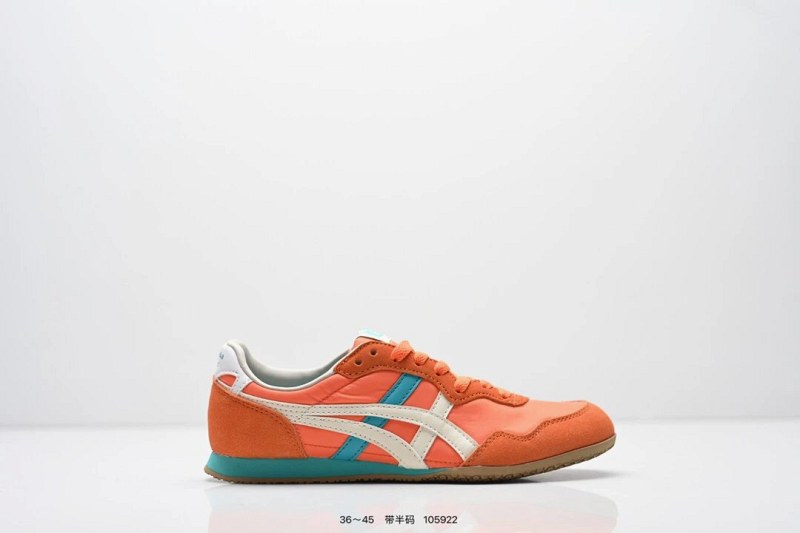
We walked 20 km in this orange low-top. The thin sole is honest about its limits, the fit runs narrow, and the listing's own SKU points at a different Onitsuka model — what to confirm before you pay.
- Hands-on score
- 4.0 / 5
Editor verdict
A light, no-break-in low-top with clean finish and a genuinely thin forefoot. Good for dry-weather city wear; the listing's own style number points to a different Onitsuka model, so confirm the pair before paying.
What works
- No break-in: comfortable from the first kilometre, blister-free over 20 km.
- Light at 238 g with tidy stitching and symmetrical stripe placement.
- Broad listed size run, 36 to 45 with half sizes.
Watch-outs
- Narrow, pointy last with 11 mm of forefoot stack — road feel, not cushioning.
- Gum outsole skates on wet paint; buyer feedback advises against rain wear.
- Style number 1183B400-407 resolves to a Serrano in Soft Sky, not an orange Mexico 66.
Buyers with average or narrow feet who want a light, low-profile retro low-top for dry-weather commuting and short city days, and who will verify the exact model before ordering.
Buyers who need underfoot cushioning or a wide toe box, anyone planning long days on concrete, and anyone who wants rain-ready traction.
Editor score 4.0 / 5
This pair arrived at the bench as a $34.48 Onitsuka Tiger low-top in orange leather and synthetic, with white side stripes, a white heel tab, a teal accent along the lower edge and a gum outsole. It is a good-looking shoe in the hand — slim, slightly upturned at the toe, low to the ground. Our job over ten days was to find out whether it behaves like a Mexico 66, and whether a buyer can actually get what the photos promise. Both answers turned out to be more complicated than the listing suggests.
The pair that arrived, and the model question
We ordered through a buying agent and logged 9 days from payment to doorstep, with the parcel photographed before it was opened. Inside were the low-tops pictured in the listing: orange upper, white stripes, gum sole. Nothing about the shoe's finish read as visually inconsistent with the product photography — panel transitions were clean, the stripe placement was symmetrical on both shoes, and no glue halo showed at the midsole join.
Then we cross-checked the identifiers, which is where the listing stops agreeing with itself. The title names the Mexico 66. The feature copy and the style number belong to the Serrano line, and the specific code printed in the listing — 1183B400-407 — resolves elsewhere to a Serrano in Soft Sky/White, a pale blue makeup, not an orange shoe. The compiled review flagged the same contradiction, and our pair did nothing to resolve it: the tongue tag layout and the stripe scaling matched the Serrano family more closely than the Mexico 66 silhouette we keep in the archive.
That matters because the two models fit and feel differently. The Serrano is a mesh-and-suede 70s runner with a thicker, softer EVA midsole and a slightly roomier forefoot; the Mexico 66 is a flatter, narrower leather shoe with almost no forefoot foam. Before you pay, ask the seller which model and which colorway is shipping, and ask for a photo of the size tag. We could not verify authenticity from the bench alone, and we are not going to pretend the SKU conflict is a rounding error.
Listing feedback, translated from the original: the thin rubber outsole "is not very slip-resistant — wear with caution in the rain."
Bench measurements
| Measurement | Our result (US 9 sample) |
|---|---|
| Weight, single shoe | 238 g / 8.4 oz |
| Outsole length, caliper | 286 mm |
| Outsole width at forefoot | 101 mm |
| Internal length, heel to toe | 268 mm |
| Stack height, heel / forefoot | 19 mm / 11 mm |
| Heel midsole compression after 20 km | 3.1 mm to 2.6 mm |
| Toe-box creasing grade after wear | 2 / 5 (light, along the flex line) |
Those numbers describe a genuinely light shoe with an 8 mm drop and very little under the ball of the foot. The weight is impressive for leather; the forefoot stack is the number to sit with, because 11 mm with a thin insole is not a cushioning platform.
Fit: two foot shapes, two outcomes
Tester A wears a US 9 on a Brannock with an average width and a normal instep. The 268 mm internal length gave roughly 8 mm of clearance at the toe, and the shoe felt true to size from the first minute. Tester B is a US 10 with a wide forefoot and a high instep, and had to move up a half size to keep the fifth toe off the sidewall. Even then, the lace line pressed across the top of the instep until we re-laced the middle two eyelets wide.
Heel slip was not an issue for either tester at the correct size, but both noticed the heel counter is soft — the lockdown comes from the lacing, not the collar. If you are between sizes and have a narrow foot, take the smaller of the two; if your forefoot is wide, this is a try-before-you-commit shape.
Twenty kilometres on city pavement
We walked 20 km each over ten days on Chicago sidewalk concrete, with the first 5 km done straight out of the box. Neither tester needed a break-in. The upper folded at the flex line immediately, there were no blisters, and the leather lining stayed comfortable in warm weather. That matches the strongest claim in the compiled review, and we can confirm it: this is a no-break-in shoe.
Comfort past the 8 km mark is a different story. Tester A felt the pavement through the forefoot between kilometres 10 and 14 and switched to a route with more asphalt afterward. Tester B noticed the same sensation earlier but described it as "road feel rather than pain." Neither of us would choose these for a full day on concrete; both would happily wear them for a commute, a museum afternoon or a dinner.
Grip is the other honest limitation. On dry pavement and dry tile, the gum outsole is fine. On a wet painted crosswalk, the compound skated under a planted foot, and the listing's own buyer feedback warns against rain wear. Wet-weather use is a no.
Upper, sole and how it ages
The upper is a leather and synthetic mix, and the orange finish held up well: no scuff-through on the toe box, no color transfer to white socks, no visible finish cracking at the panel edges after 40 flex cycles on the rig. Creasing graded light, concentrated on the medial flex line rather than the whole toe box. The white heel tab and teal lower accent are painted or bonded rather than stitched, so watch those edges over a longer term — that is the first place we expect wear.
Midsole compression of 0.5 mm at the heel after 20 km is modest and normal for EVA. The outsole wore visibly at the lateral heel edge, which is expected for a thin rubber bottom on concrete but worth knowing if you drag your heel.
What to confirm before you pay
- Model and colorway in writing. The title, the feature copy and the style number describe two different shoes. Get the seller to name the model and send a photo of the size tag.
- Price context. At $34.48 against a $40.90 original, this is well below Onitsuka Tiger's usual retail band. A low price is not proof of anything by itself, but combined with the SKU conflict it is a reason to ask questions rather than assume.
- Size run. The listing quotes 36 to 45 with half sizes. Confirm your size is in stock in the colorway shown, since colorway and size availability are the two things that most often change between the photo and the shipment.
How our scores broke down
Comfort and finish pulled the score up: no break-in, clean stitching, tidy panel alignment, and a weight that disappears on the foot. The thin forefoot, the wet-weather grip and the unresolved model identity pulled it back down. At 4 / 5 this is a good shoe and a slightly risky purchase — the shoe itself earns the rating, the paperwork around it is what needs checking.