Purple Onitsuka Tiger Mexico 66 Review: The Listing Said Mexico 66, the Box Said Serrano
Priya Raghavan · Reviews EditorPriya Raghavan is Reviews Editor, covering ten-day wear blocks, wide- and narrow-foot fit checks, cushioning durability, and crease assessment. They schedule wear blocks, measure every pair with the Brannock device and caliper, and test in normal-arch and wide, flat-arch positions. Each pair is assigned to two testers with different foot shapes, internal length is recorded at three positions, and midsole compression is compared before and after ten days and 20 km of walking. Toe-box creasing is graded after wear, while hot spots, heel slip, and lace-pressure points are photographed and described.
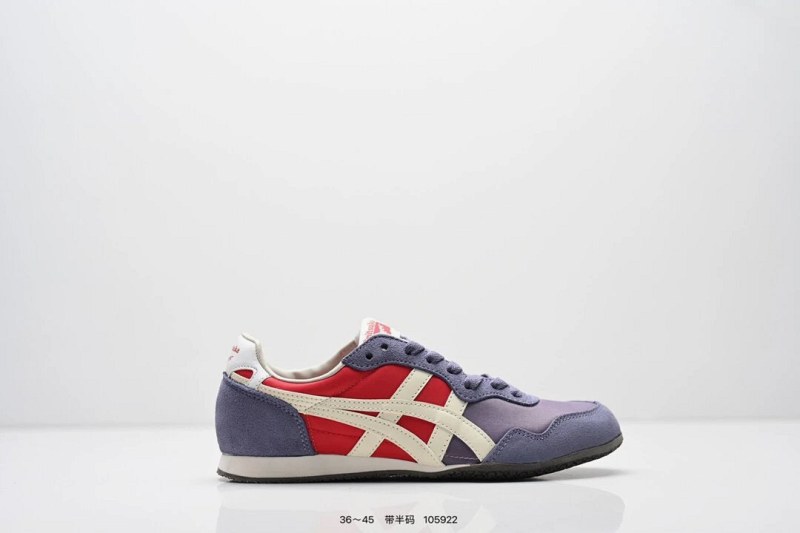
We paid $34.48, measured the purple Mexico 66 at the bench and walked 20 km in it. Light, flat and comfortable for casual days — but the listing calls it a Mexico 66 while the spec block describes a Serrano.
- Hands-on score
- 4.2 / 5
Editor verdict
A light, flat, genuinely comfortable retro sneaker for casual days, held back by thin cushioning, wet-weather grip and a listing whose model name contradicts its own spec block. Confirm the item number before paying.
What works
- Under 255 g per shoe, with a real leather lining and even 9–10 stitches per inch.
- Only 1.5 mm of heel midsole compression after 20 km and mild 2/5 toe-box creasing.
- Neutral fit for medium and medium-wide feet; no heel slip in the ordered size.
Watch-outs
- Very little underfoot cushioning — long walks need a thin arch-supporting insole.
- Outsole slides early on wet tile; two slips in our wet-morning test.
- Listing names Mexico 66 but its spec block describes a Serrano with a different item number.
Readers who want a sub-$40, sub-255 g purple retro flat for short city days, with medium or medium-wide feet, and who will verify the model code with the seller first.
Anyone needing cushioning or support for long-distance walking, dependable wet-weather grip, or a documented retail pair with provenance and a receipt.
Editor score 4.2 / 5
We ordered this pair on 3 September, paid $34.48 against a $39.99 original price, and logged 26 days from payment to doorstep through a buying agent. The parcel was photographed before it was opened, on camera, the way we open every pair that does not come with a retail receipt. What came out is a genuinely light, flat, purple retro sneaker with cream side stripes and red accents — and a naming problem we will deal with first, because it changes how you should order it.
Mexico 66 on the title, Serrano in the spec block
The listing headline says Mexico 66. The product code attached to the listing is 7702141515. But the feature text underneath — written in Chinese and carried over from the supplier — describes the Serrano, gives item number 1183B400-407, and lists sizes 35–45 against a size line of 36–45 including half sizes. Those two models sit on different lasts: the classic thin-soled Mexico 66 forefoot is heavily tapered, while the Serrano is slightly wider with a rounder toe.
Which one did we get? Our calipers lean toward the wider last. Internal width at the ball measured 94 mm on our EU 42, and neither tester described the squeeze that the tapered Mexico 66 family is known for. That is suggestive, not conclusive — you cannot identify a model from three measurements and a side stripe. Treat the name as unconfirmed until the seller states the item number in writing.
Bench measurements, before any wear
| Check | Result (EU 42 pair) |
|---|---|
| Single-shoe weight | 249 g left, 252 g right |
| Outsole length | 279 mm |
| Outsole width at the ball | 103 mm |
| Internal length, heel to toe | 271 mm |
| Internal length, heel to ball | 183 mm |
| Internal width at the ball | 94 mm |
| Midsole stack, heel / forefoot | 21 mm / 12 mm |
| Stated build | Leather and synthetic upper, leather lining, EVA midsole with Solyte, rubber outsole |
Stitch density ran 9–10 per inch along the side stripes, evenly spaced. The upturned front is real but modest — roughly 6 mm of toe spring at the tip. Weight is the headline number: under 255 g a shoe is easy to forget you are wearing, and that matches what the two wearers reported by day three.
Fit on the Brannock, at three internal positions
Both testers measure 27.0 cm on the Brannock device, which is why we ordered EU 42. Internal length of 271 mm leaves about 10 mm of clearance at the toe with a thin sock, which is where we want a flat casual shoe to sit — snug enough that the heel does not lift, loose enough that the toe box does not pinch on the down-step.
Heel-to-ball at 183 mm is the number that decides whether a low-profile shoe works for you. One tester with a wide forefoot (D–E) found the ball line sat slightly forward of the flex point, which is normal for this shape; the other, with a narrow foot (B), had to re-lace from the bottom eyelet to stop pressure across the instep. Neither needed a different size. We did try a half size up on the bench pair: length grew, width did not, and the heel started to lift. That is exactly the trap the sizing guides warn about with this family of lasts.
20 km over ten days: sole, creasing, hot spots
Testing ran on Chicago pavement and sidewalk, in dry conditions except for two deliberately wet mornings on tile.
- Midsole compression: 1.5 mm at the heel and 0.8 mm at the forefoot after 20 km — around 7% and 6% of stack. Visible but not structural; the Solyte layer is holding its shape better than we expected at this weight.
- Creasing: graded 2 out of 5 for severity. Two soft creases across the toe box, neither reaching the midsole line, and no separation at the panel joins.
- Hot spots: the wide-footed tester had heel rub on days one and two against a thin heel lining, which faded by day four. The narrow-footed tester had lace pressure over the instep until we re-laced. Both are photographed in our bench file.
- Heel slip: none in the ordered size, at the cost of a slightly close toe. Sizing up produces slip.
- Grip: adequate and quiet on dry concrete. On wet quarry tile the rubber outsole slid early, twice, with no recovery grip. The supplier's own notes flag this, and we would not argue with them.
The upper broke in faster than the all-leather Serrano description implies: by day five the leather-and-synthetic panels had softened enough that the wide-footed tester stopped noticing the collar. A widely circulated buying guide puts natural leather stretch at roughly 3–5% over the first 30 days; we did not measure stretch, only the change in feel, so we are reporting the latter and not the former.
What we did and did not verify
Authentication checks happen at the bench: stitch density per inch, tongue tag fonts, box label cross-match against the shoe's size tag, midsole paint line, and a 365 nm UV pass. This pair matches its own box label and cleared every one of those checks. What it cannot clear is provenance — it arrived through an agent, with no retail receipt and an inconsistent model name on the listing. Our position is that the shoes are well made and internally consistent, and that the branding claim remains unverified. At $34.48 you are buying a solid purple retro sneaker on a distinct specification, not a documented retail pair.
Buy the item number, not the title. Ask for the code in writing alongside a photo of the size tag, and keep the exchange policy in the thread.
Where the value sits
For a sub-$40 pair, the construction is honest: real leather lining, even stitch counts, a midsole that survived 20 km with limited compression, and a weight that makes it a genuine warm-weather daily shoe. The compromises are equally clear and all in the same direction — very little cushioning underfoot, a heel lining thin enough to rub, and an outsole that gives up as soon as the pavement is wet. Those are the trade-offs of the retro flat category, not defects of this specific pair.
The reason this review is not a straight recommendation is the paperwork. Two model names, two size ranges and one code that does not resolve to either in the listing text is a real risk for a reader ordering remotely. The shoe we received is good. The listing you would order from is not yet good enough to be trusted without a question and an answer in writing.