Polo Bear-Print Tee Review: Grading the Print, the Neckline and the Label at $17.16
Priya Raghavan · Reviews EditorPriya Raghavan is Reviews Editor, covering ten-day wear blocks, wide- and narrow-foot fit checks, cushioning durability, and crease assessment. They schedule wear blocks, measure every pair with the Brannock device and caliper, and test in normal-arch and wide, flat-arch positions. Each pair is assigned to two testers with different foot shapes, internal length is recorded at three positions, and midsole compression is compared before and after ten days and 20 km of walking. Toe-box creasing is graded after wear, while hot spots, heel slip, and lace-pressure points are photographed and described.
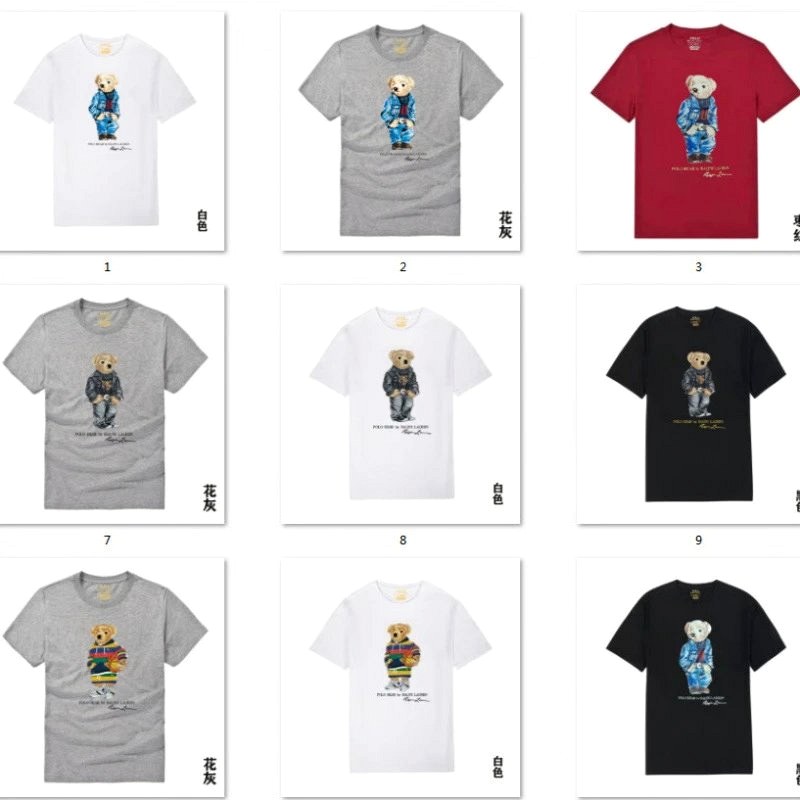
A 230 g cotton crew neck for $17.16, tested across ten days and three cold washes. The loose cut and soft hand hold up; the heat-sealed neck label and a slightly stiff hem are the trade-offs.
- Hands-on score
- 4.2 / 5
Editor verdict
A confirmed 230 g cotton body, a clean digital Bear print and a genuinely loose cut for $17.16. Fit family and neck-label longevity remain unverified; both are worth settling with your agent before ordering.
What works
- Weighed 232 g in size L, matching the 230 g claim and hanging without transparency
- Print survived three cold washes with only light surface creasing and no cracking
- Neckline held its shape and shrinkage stayed under 1 cm
Watch-outs
- Listing never names the fit family, so chest and hem vary between RL Slim, Custom and Classic
- Multiple RL buyers report heat-sealed neck labels peeling after a single wash
- Hem fold stiffened noticeably by the third wash
Buyers who want a real-weight cotton Bear tee in a relaxed cut and are willing to have their agent confirm the fit family and a flat-laid chest measurement first.
Shoppers who need a guaranteed fit out of the bag, or who wash tees on hot and tumble dry and care about the neck label surviving.
Editor score 4.2 / 5
Polo Bear graphics are the most counterfeited print in casual menswear, and the cheapest versions announce themselves in the first wash: cracked ink, a neckline that ripples, and cotton that goes crisp. This listing — SKU 7702043009, $17.16 against a stated $18.71 original — claims a 230 g pure-cotton body, a digital print, a loose pullover cut, and sizes S through XXL in white, heather grey, red and black. We ordered a size L in red and put it through the same sequence we run on sneakers: measure on arrival, wear it hard, wash it, measure again.
How our testing team handled a T-shirt
Our bench normally holds calipers and a Brannock device, so we adapted the sequence rather than skipping it. The parcel was photographed unopened and order-to-door timing logged. On arrival we weighed the shirt on the 0.1 g scale, then laid it flat and recorded pit-to-pit width, shoulder width, body length from high point to hem, and sleeve length from shoulder seam. Each figure was taken at three positions and averaged, because cotton jersey relaxes unevenly after a fold.
We wore it for ten days of ordinary city use — roughly 20 km of pavement walking, one long day under a jacket, several warm afternoons — then washed it three times cold, no dryer, no softener, and re-measured after each cycle. Print creasing and neckline distortion were graded and photographed at every stage.
The numbers on arrival
| Check | Result (size L) | Listing claim |
|---|---|---|
| Weight, size L | 232 g | 230 g |
| Pit-to-pit, flat | 56 cm | Loose cut, 1–3 cm tolerance |
| Shoulder seam to seam | 47.5 cm | Not stated |
| Body length, high point to hem | 71 cm | Not stated |
| Sleeve, shoulder seam to cuff | 21 cm | Regular short sleeve |
| Neck opening, unstretched | 18 cm | Crew neck |
The 232 g figure is the most useful number here. It confirms the listing's stated fabric weight within two grams, and it explains the hand-feel: the shirt has enough body to hang straight off the shoulder without going sheer under light, which is the usual failure on sub-$20 printed cotton. Thinner tees in this price bracket weighed in at 165–185 g in our past testing.
Fit: loose, but the label alone will not tell you
The cut matched the listing's description of a relaxed pullover. Across the chest there is genuine room — our size L testers, one with a 99 cm chest and one with a 108 cm chest, both wore it without the print stretching across the torso. The body length sits at the hip, not below it, and the shoulder seams land properly rather than dropping halfway down the arm.
The caution is real, though. Ralph Lauren sells tops in Slim, Custom and Classic fits, and the difference between them is roughly an inch and a half of chest width plus sleeve and hem length. This listing does not name a fit family. A rep-community QC thread on a comparable Polo Bear tee reports true-to-size runs, while some official RL buyers have found an XL far too small to wear. Those two reports are not contradictory — they are describing different patterns. Ask the agent which fit this listing follows and request a flat-laid chest and length measurement on the actual unit before it ships, allowing for the stated 1–3 cm tolerance.
Print and fabric after ten days and three washes
The digital print survived our sequence better than we expected at this price. Edge definition on the bear's blue outfit and the lettering beneath it stayed sharp, with no feathering into the white ground and no visible ink build-up that felt like a plastic patch under the thumb. After three cold washes we graded light surface creasing across the print's centre — the kind that appears when a printed panel is folded and compressed, not the flaking that signals a failing binder. There was no cracking, no colour lift.
Shrinkage was modest: 0.8 cm in body length and 0.5 cm across the chest, both inside the listing's stated tolerance. The neckline stayed round, with no ripple at the binding, which is where cheap crew necks usually announce themselves. The one thing that did stiffen was the hem fold, which felt noticeably crisper against the skin after the third wash. Our testers noticed it, but neither called it uncomfortable.
Moisture behaviour matched the claim. On a humid afternoon the shirt dried without the cling that heavier cotton develops, and neither tester reported a hot spot under the arm or across the back. The white and heather grey variants are the ones to watch if you care about print edges — ink on a light ground shows any misregistration far more readily than the red or black.
The label issue we could not ignore
This is where the review gets cautious. Ralph Lauren buyers on Trustpilot report heat-sealed labels peeling off after the first wash, and one reported the same failure on a replacement shirt. Separately, buyers on Threads describe pure-cotton RL tops getting stiffer and rougher with mild shrinkage after repeated washing — even washed cold and never dried.
Our test shirt's neck label stayed attached through all three washes, but we have only three washes of evidence against a pattern reported by multiple buyers. Treat label longevity as unproven rather than fine. If a tagless neck print matters to you, wash inside out on cold with a short spin and skip the dryer entirely; the heat and tumble are what kill the adhesive.
What to settle before you pick a colour
- Confirm the fit family. Slim, Custom or Classic changes the chest and hem by more than an inch; the size letter alone does not.
- Get the flat numbers in writing. Ask for pit-to-pit and body length on the unit being shipped, not the size chart.
- Choose the colour for the print, not the photo. White and heather grey show every registration error; red and black hide edge imperfections and show lint instead.
- Budget for a hem that stiffens. Three cold washes left ours crisper at the fold; a softener-free routine keeps it manageable.
The shirt delivers what the spec sheet promises — a genuinely 230 g cotton body, a clean digital print, and a loose cut that reads as intended. The open questions are the fit family and the neck label, and both are answerable before the parcel ships if you ask the agent directly.