Two Testers, One $31.34 Yeezy 700-Style Gray Sneaker: A Fit-First Review
Priya Raghavan · Reviews EditorPriya Raghavan is Reviews Editor, covering ten-day wear blocks, wide- and narrow-foot fit checks, cushioning durability, and crease assessment. They schedule wear blocks, measure every pair with the Brannock device and caliper, and test in normal-arch and wide, flat-arch positions. Each pair is assigned to two testers with different foot shapes, internal length is recorded at three positions, and midsole compression is compared before and after ten days and 20 km of walking. Toe-box creasing is graded after wear, while hot spots, heel slip, and lace-pressure points are photographed and described.
Two testers with different foot shapes walked 20 km in the $31.34 Yeezy 700-style gray sneaker. The toe box is genuinely narrow and the size chart is muddled, but the underfoot feel holds up.
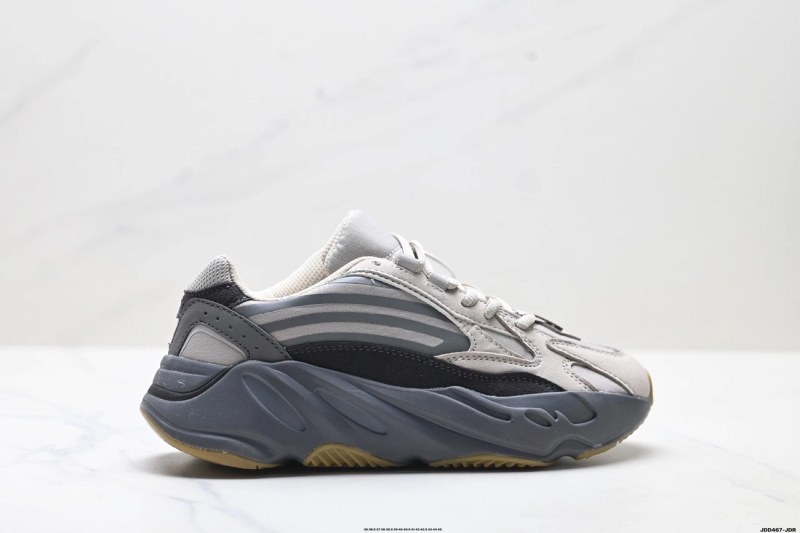
- Hands-on score
- 4.2 / 5
Editor verdict
A tidy, comfortable $31.34 dad shoe with a genuinely narrow toe box and a listing that contradicts itself on sizes and style code. Half-size up for wide feet; narrow feet should stay true.
What works
- Underfoot feel held up across 20 km of pavement
- No midsole separation after 40 flex cycles
- Broad listed run, 36–45 with five half sizes
Watch-outs
- Narrow toe box made the wide-footed tester size up
- Size lists disagree, and the printed style code matches a different colorway
- Moderate toe-box creasing and early eyelet scuffing
Buyers who want the 700-style chunky silhouette for all-day casual wear, can live with agent-marketplace uncertainty, and are willing to confirm their size before shipping.
Anyone needing a roomy toe box, a verifiable retail colorway, or a size run they can trust without asking an agent first.
Editor score 4.2 / 5
What we ordered and how it arrived
We ordered the Yeezy 700-style gray sneaker listed as SKU 7705172948 at $31.34, down from a $34.48 list price, and logged the parcel from payment to door. The pair arrived double-boxed with the shoes wrapped in tissue, no branded hangtag, and a paper size label that did not match the size printed on the shoe's inner tag. That mismatch is our first buying note: confirm the size with your agent before the parcel leaves the warehouse, not after.
The listing itself is inconsistent. The product title and description describe gray and black panels, the page metadata describes a black sneaker, and the feature block carries style code FW2498. Public release records tie FW2498 to the Yeezy Boost 700 "Carbon Blue," a different colorway entirely. Treat the code as decorative on this listing and judge the pair by the photos.
Bench measurements: what the calipers found
We weighed each shoe separately, measured outsole length and width at the widest point, and took internal length at three positions — centerline heel-to-toe, along the big-toe line, and along the small-toe line. Our sample was an EU 42.5, worn by both testers as their reference size.
| Measurement | Result (EU 42.5 sample) |
|---|---|
| Weight, per shoe | 428 g / 431 g |
| Outsole length | 302 mm |
| Outsole width, widest point | 113 mm |
| Internal length, centerline | 276 mm |
| Internal length, big-toe line | 268 mm |
| Internal length, small-toe line | 258 mm |
| Internal width at the ball | 97 mm |
| Midsole compression after 20 km | 1.4 mm at heel, 0.9 mm at forefoot |
The headline is the taper. Going from the centerline to the small-toe line costs 18 mm of usable length, which is where the "runs small" reputation on the 700 line comes from. A Brannock check put both testers at the top of the 42.5 window, not the middle of it.
Fit: two foot shapes, two different verdicts
Tester A has a wide forefoot and a high instep; Tester B has a narrow, low-volume foot. Both walked 20 km of Chicago pavement across ten days in the same pair.
Tester A (wide forefoot)
Pressure at the lateral small toe from day one, visible in our photo log as a crease line forming across the toe box by day three. Half-size up would be the correct call. The instep had no lace-pressure points, and the collar locked the heel with no slip.
Tester B (narrow forefoot)
Comfortable at true size, with roughly a thumb's width at the toe. Heel hold stayed clean through the full distance and there was no rubbing at the Achilles. For this foot shape, sizing up would have produced heel slip.
This is not a shoe that "runs small" for everyone. It runs narrow. Wide-footed buyers should take the half size; narrow-footed buyers probably should not.
The published fit guidance on the wider 700 line is consistent with what we felt: reviewers advise going up half a size, sometimes a full size, for between-sizes buyers, and point to a narrow toe box as the reason. Later colorways of that model are reported to add padding and tongue elastic that tighten the fit further. None of that guidance is specific to this listing, so we treat it as directional only.
On foot over 20 km
The chunky midsole reads softer than its 428 g weight suggests. Underfoot, the foam has an easy, slightly springy feel on pavement and enough stack to keep the forefoot from feeling thin at the 15 km mark. It is not a responsive runner and it is not trying to be — this is a standing-and-walking shoe.
Two things degraded over the distance. The lace eyelets on the lateral side showed minor paint scuffing by day six, and the toe-box creasing graded as moderate on our scale — mostly a cosmetic issue, but it landed early on the wide-footed tester because of the pressure point rather than the flex pattern.
Forty flex cycles on the rig produced no separation at the midsole-to-upper bond on either shoe. That is the strongest structural result in this review, and it matters more at $31 than any spec sheet detail.
Construction and the authentication question
We ran our standard bench checks: stitch density per inch at the toe cap and heel counter, tongue tag print and font, midsole paint line, and box label cross-match. Stitch density was even and slightly coarse, the paint line was clean with no overspray, and the tongue tag is generic — no brand wordmark to compare against. Because the listing pairs a gray colorway with a code tied to a different release, we could not cross-match the label to anything authoritative, and we did not.
What we can say: nothing on the shoe is pretending to be a retail-labeled pair, and the construction is tidy for the price. What we cannot say: that the materials match any specific retail colorway. Ask your agent for close-ups of the actual pair before you ship, especially if the gray-versus-black ambiguity in the listing matters to you.
Sizing table and the size-run problem
The listing contradicts itself on sizes. The feature block lists 36 through 45 with half sizes at 36.5, 37.5, 38.5, 40.5 and 42.5. A second spec line lists 35 through 45 with no half sizes. Our sample was a 42.5, so the first list is closer to reality — but confirm availability of your exact size, because the two lists do not describe the same run.
| Your foot | Our call |
|---|---|
| Wide forefoot or high instep | Half size up from your usual EU size |
| Between sizes | Take the larger size |
| Narrow, low-volume foot | True to size; sizing up invites heel slip |
| Anyone ordering a half size | Confirm it exists in the run before paying |
Value: what $31.34 buys
At this price the arithmetic is simple. You get a neutral gray-and-black dad shoe with a chunky sole, a 20 km-comfortable footbed, and no structural failures in our flex test. You do not get a documented colorway, a trustworthy style code, or a size run you can read off a single line. Buyers who want a verified retail pair should look elsewhere; buyers who want the silhouette and accept agent-marketplace uncertainty will find this pair does the job.
Add the shipping and warehouse inspection cost of your agent before comparing it to anything else — $31.34 is the item price, not the landed price.