Givenchy Knitwear: Spreadsheet vs Google Sheets
Marcus Delgado · Editor in ChiefMarcus Delgado is Editor in Chief, covering Air Jordan silhouette history, retail launch timing, size-run fit mapping, and final score calls. They buy at retail where possible and use buying agents otherwise, filming the unboxing and checking the box label against the size tag. Marcus sets the final hands-on score after each ten-day wear block, with testing including 20 km of city pavement and a flex-cycle stress test they conduct personally. They sign off on the comparison table against two prior-year equivalents, connecting fit judgments, wear records, and comparisons.
## What Purchase Task Does This Givenchy Knitwear Tracking Aim to Solve If you're browsing [Givenchy](https://fashion-reps.net/brand/givenchy) knitwear candidates on [fashionreps](https://fashion-reps.net/), the real challenge is usually not "finding an item that looks good" but gathering sizing, color, fit, images, and fall/winter styling ideas from multiple pages into one place for comparison, ultimately creating a shortlist you can verify further. 📋 This article is for those who need to mana
Editor score 4.2 / 5
What Purchase Task Does This Givenchy Knitwear Tracking Aim to Solve
If you're browsing Givenchy knitwear candidates on fashionreps, the real challenge is usually not "finding an item that looks good" but gathering sizing, color, fit, images, and fall/winter styling ideas from multiple pages into one place for comparison, ultimately creating a shortlist you can verify further. 📋
This article is for those who need to manage multiple candidates at once, tend to forget page details, or want to organize purchase plans with a partner. After reading, you should be able to do three things: create a candidate record, distinguish between page facts and personal judgments, and identify any missing size or product information before ordering.
The article does not treat unlisted prices, stock, materials, size accuracy, or link stability as established facts. They should all be re-verified when actually opening the product page, and you should note the verification date, destination, currency, and other conditions. 🗓️
How the fashionreps Spreadsheet Helps Discover Knitwear Candidates and View Visible Fields
Start by browsing fashionreps' product catalog or category entries. The site's visible navigation includes product browsing, brands, blog, authors, and usage guides. Product pages may display item names, SKUs, style quantities, images, or QC photo sets. Field completeness varies from page to page, so don't judge a knit's size, material, or fit based solely on the listing thumbnail.
When searching, start with natural terms like Givenchy, knitwear, sweater, cardigan, crewneck, then narrow down by color or seasonal use. Search result titles, brand tags, and images only help you discover candidates; they don't replace on-page verification.
For every candidate page you open, record the following:
- Product name and SKU shown on the page
- Original page URL and date recorded
- Visible color, size, material, or fit fields
- Whether there are multiple product images or QC photos
- Whether you can access details, images, or agent purchase entry
- Any limitations, missing items, or unusual notes explicitly stated on the page
Browsing images is especially useful for checking pattern placement, neckline construction, cuff design, and overall color tone, but images cannot prove actual fabric feel, thickness, warmth, or fit. If a page only has blurry images, a single angle, or lacks details, record these as items to verify rather than filling in speculative values. 🔍

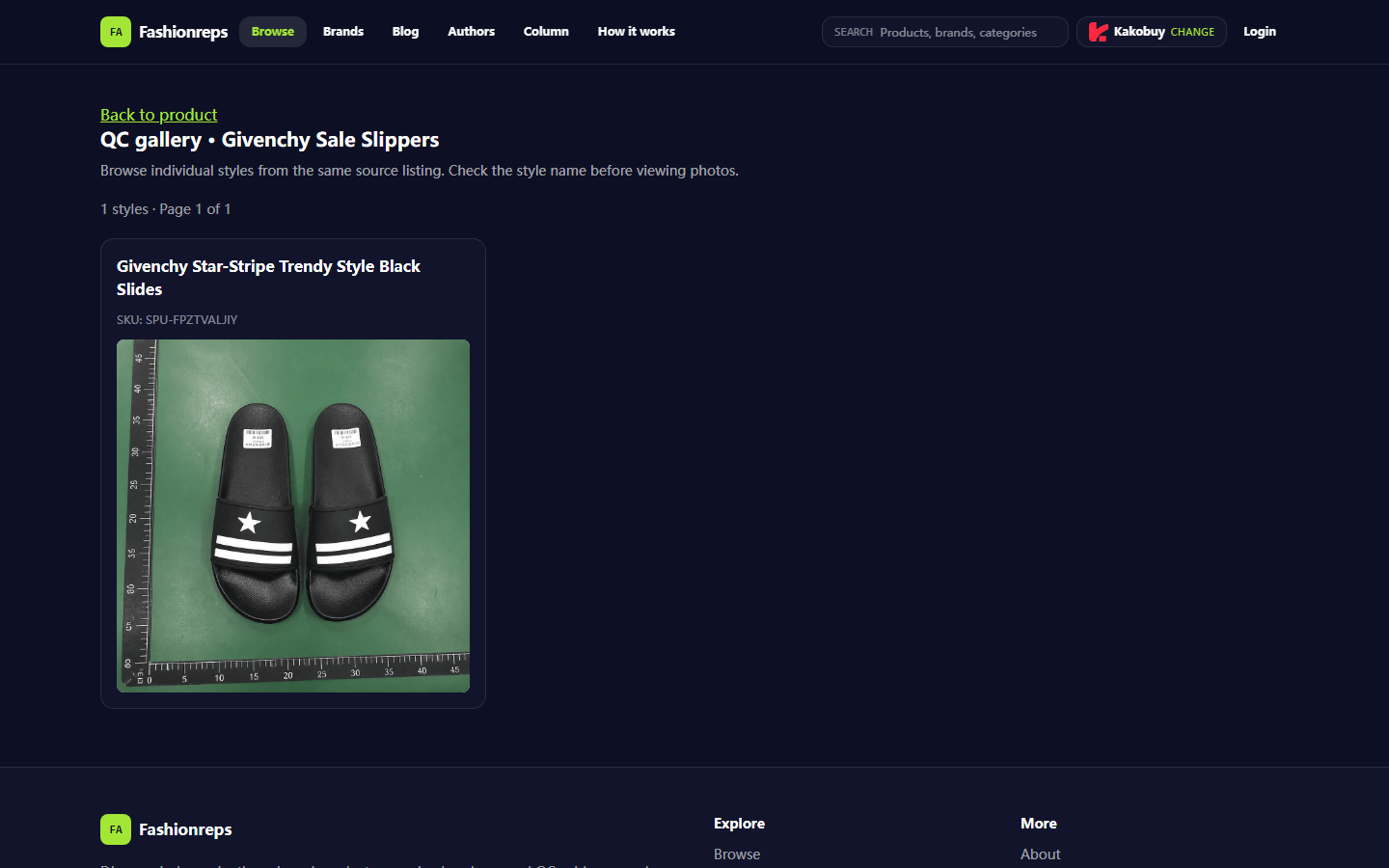
Image: Example of browsing product pages and QC photo sets on the site. The image shows a QC page for another Givenchy item, used to illustrate navigation and image verification methods, not as evidence of knitwear material or size.
How to Set Up Size, Color, Fit, and Styling Note Columns in Google Sheets
Google Sheets is better for turning scattered pages into a filterable, expandable, and collaborative record. Use the first row for field names, and put only one candidate per row thereafter. Avoid writing multiple products or sizes in a single cell.
You can use the following basic structure:
| Field | What to Record | Purpose |
|---|---|---|
| Product Name / SKU | Exact text from the page | Helps return to the original page for review |
| Page URL | Product or image page address | Tracks link changes |
| Color | Colors explicitly shown on the page | Avoids misreading colors |
| Size Info | Size chart, available sizes, or "not shown" | Distinguishes verified vs. missing |
| Fit Assessment | Loose, fitted, unknown | Only record evidence-based judgments |
| Fall/Winter Outfit | Outerwear, pants, shoes, or scenarios | Manages styling plans |
| Image Status | Clear, insufficient angles, missing details | Determines if further verification is needed |
| Items to Confirm | Size, material, stock, or link issues | Forms a pre-order checklist |
| Verification Date | Year-month-day | Prevents treating old info as current facts |
In Google Sheets, you can set dropdown options for fields like "Color," "Image Status," and "Candidate Stage," and enable filtering for "Items to Confirm." This lets you quickly see all products with "size not shown" or "link needs review" without scrolling through the entire catalog.
If multiple people are organizing together, keep factual records separate from discussion notes. For example, "page color" holds the exact text, "styling notes" holds personal plans, and "editorial judgment" holds whether it's worth further verification. This way, even if someone changes the styling plan, they won't accidentally alter the product page facts.
How Product Page Info Corresponds to Your Personal Fall/Winter Styling Needs
When recording Givenchy knitwear, the styling columns should serve actual decisions, not pile up adjectives. Start by defining your use scenarios, then decide whether a candidate is worth keeping:
- Daily office wear: Focus on whether the color easily pairs with dark or neutral outerwear
- Indoor wear: Note whether the neckline and thickness info supports layering
- Cold-weather outings: Don't judge warmth from images alone; list material and thickness as items to confirm
- Layering use: Note if extra room under a jacket is needed, but don't write unknown fits as definite conclusions
- Autumn transition: Prioritize marking color schemes that work with shirts, light jackets, or straight-leg pants
The same knit can have multiple styling plans, but it's best to separate "confirmed page facts" and "personal styling ideas" into two columns. For example, page shows black is a fact; "pairs well with a gray coat" is a plan; "definitely slimming" is an unsupported exaggerated judgment and should not be written as a conclusion.
Differences in Using Site Category Browsing vs. Spreadsheet Filtering Across Devices
The site catalog is better for discovering candidates. You can browse via categories, brand entries, keyword search, product images, and QC photo sets. On mobile, images and page links are quicker to open; on desktop, it's easier to compare product pages, image pages, and Google Sheets side by side.
Google Sheets is better for organizing candidates and collaboratively adding information, but it cannot automatically prove that product page data is true, current, or complete. When copying page content, keep the original wording and fill in unverifiable items as "not shown," "to verify," or "page won't open"—don't fill in guesses.
| Use Case | Site Catalog or Product Page | Google Sheets |
|---|---|---|
| Discovering candidates | Easier to browse by category, brand, and images | Good for consolidating found candidates |
| Viewing images | Directly opens product or QC photos | Can record image status and notes |
| Comparing sizes | Requires viewing visible fields page by page | Can filter missing items and compare uniformly |
| Link tracking | Can see if the page is still accessible | Can save original URL, date, and review status |
| Collaborative organizing | Good for sharing specific product pages | Good for multiple people adding and filtering |
| Risk control | Cannot guarantee all fields are complete | Cannot replace page and pre-order verification |
Device differences also affect recording quality. On mobile, copying long page URLs or viewing size charts side by side may be inconvenient; on desktop, it's easier to line up multiple tabs with the spreadsheet. Regardless of device, avoid saving only screenshots without the product name, SKU, and page URL. 📱
How to Keep Items to Verify When Specs, Links, or Seasonal Fit Are Unclear
If a page lacks a size chart, don't extrapolate from model proportions or other products' measurements. Write "page not shown" in the "Size Info" column and note the specific details you need to confirm with the product page or agent in the "Items to Confirm" column.
If a link redirects, shows a blank page, fails to load images, or the product name changes, mark the status as "link needs review." Don't use search result summaries to replace the product page, and don't copy SKUs, colors, or sizes from similar products.
For candidates with unclear fall/winter suitability, rank by evidence strength:
- Confirmed: Color, size, product name, or images explicitly shown on the page
- Partially confirmed: Product images visible, but material, thickness, or fit information missing
- Planned: Styling ideas based on your personal wardrobe
- To verify: Information that needs rechecking the page or confirming with the agent
- On hold: Broken link, missing key fields, or can't tell if it's the target product
This ranking prevents writing "want to buy" as "confirmed." If a page updates, keep the original record and old verification date, then add a new review note rather than silently overwriting previous judgments.
How to Distinguish Page Facts, Styling Plans, and Editorial Judgments
A practical method is to write each note as a short sentence with a source. For example:
- Page fact: The product page shows the color as black, verified on [date]
- Styling plan: Plan to pair with a gray coat and straight-leg pants
- Editorial judgment: The color combination likely fits into the existing fall/winter wardrobe, but the fit still needs confirmation
- Risk warning: The page does not provide material or thickness information, so warmth cannot be judged from it
Editorial judgments can help you narrow down candidates, but they must not be disguised as product test results. This article also does not claim to have personally purchased, received, worn, or tested these knits; final judgment should be based on the pages you actually open, visible images, size information, and pre-order verification.
Pre-Order Steps After Finalizing Your Givenchy Knitwear Candidate Sheet
After completing the sheet, first filter for candidates where "page is still accessible," "size info is relatively complete," and "images are sufficient to judge design details." Then perform pre-order verification item by item:
- Reopen the product page and confirm the name, SKU, color, and available sizes have not changed.
- Check if product images or QC photos are still present, and note any details you cannot confirm.
- Compare your body measurements with the page's size info; don't just pick your usual size.
- Confirm high-volatility information like material, thickness, fit, stock, and price, and note the verification date.
- Check the agent purchase entry, shipping fees, destination taxes, return conditions, and possible route restrictions.
- Save any questions that still need follow-up, and update the sheet status only after confirmation.
The value of the final candidate sheet is not to guarantee that a knit will fit you, but to make clear which information you have seen, which is just a styling plan, and which still cannot be concluded. This way, the site catalog handles discovery and viewing, Google Sheets handles filtering and collaboration, and purchasing decisions are based on the latest page evidence and personal needs. ✅
Agent Platform Shopping FAQ
1. What is the purpose of using a spreadsheet on usfansus.com?
Most agent platforms do not show their products directly, so a spreadsheet becomes necessary to browse the items you want and obtain their purchase links. Another option is to ask for help on Reddit or Discord—the suggestions there are often very good, but the buying process can be slow. These spreadsheets are usually built slowly over time by collecting information from those platforms.
2. Which platform offers the best coupon deal for usfansus.com users?
I suggest Kakobuy because it currently has a $15 discount code with no minimum spend required. This is a great option for users placing small orders. The promo code is kakobuy888.
3. How can I search for items I want to buy on usfansus.com?
You can search with a single keyword or go straight to the category page, where products are also arranged by brand. Longer search phrases usually yield fewer results than shorter ones, but they are more precise.
For instance, you could search for "Air Force 1 White," "sneakers," or just "Air Force 1."
4. Is the spreadsheet website usfansus.com safe to use?
This website does not gather any personal information; it acts only as a product catalog for the agent platform. All transactions are completed on the agent platform.
5. How do I properly view QC photos on usfansus.com?
When reviewing QC photos, you should pay attention to the specific features of the item you bought. For shoes, you need to check several important areas—such as the toe, heel, and tongue—to examine the stitching, the shoe's overall shape, and the tongue's thickness to determine if it is a high-quality pair. For clothing, you should look at the label at the collar, the logo embroidery, the fabric, and the smoothness of the collar and cuffs, among other details.